
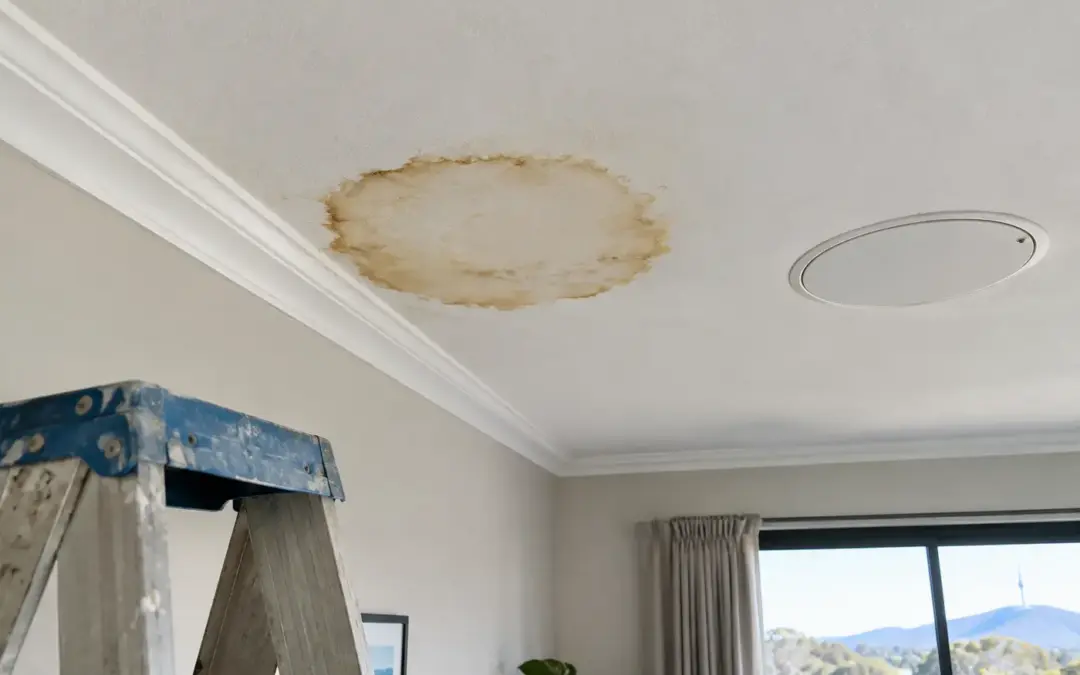
It usually starts small. You’re lying on the couch after a storm, or you flick on the hallway light on a frosty July morning, and there it is: a brown ring on the ceiling that wasn’t there last month. Most people’s first thought is that the roof is leaking. Sometimes it is. But a water stain on the ceiling has a handful of possible causes, and working out which one you have before you call anyone saves time, money and a fair bit of worry.
We inspect a lot of stained ceilings around Canberra. Here’s how we read them, and what you can check yourself from the ground and the manhole.
First, make sure the ceiling is safe
Before you work out the cause, look at the ceiling itself. If the plaster is sagging, bulging or soft to look at, water may be pooling on top of it. Keep people out from under that spot, move furniture away, and don’t push on it.
If the stain is near a light fitting, downlight or ceiling fan, turn that circuit off at the switchboard and leave it off until an electrician has looked. Water and wiring in the same cavity is the one part of this that can’t wait.
A dry, flat stain with no sag is a different story. You have time to investigate properly.
The timing of the stain tells you most of the story
The single most useful question we ask homeowners is simple: when did it appear, and does it change?
- Appears or darkens after rain: almost always the roof, gutters or flashings.
- Appears on cold, still mornings with no rain: often condensation in the roof space.
- Grows slowly regardless of weather: usually plumbing, such as a pipe joint above the ceiling.
- Sits under a bathroom or near the hot water system: check the plumbing before the roof.
- Shows up when the air conditioner is running: a blocked or cracked condensate tray is a common culprit.
Take a photo of the stain each time it rains and draw a pencil line around its edge. If the line moves out after a downpour, you’ve learned more than any guess could tell you.
Where roof leaks actually come from
When the stain is rain related, the leak is rarely directly above it. Water gets in at one point, runs along a rafter, a batten or the top of the sarking (the foil layer under some roofs), then drops onto the ceiling somewhere else. On older Canberra homes we often trace a stain in a bedroom back to a spot a couple of metres away.
On tile roofs, the usual entry points are:
- cracked or slipped tiles, often after hail or someone walking on the roof
- ridge capping where the old mortar bedding has cracked and let water in along the top of the roof
- valleys, the metal channels where two roof slopes meet, that are rusted or blocked with leaves
- flashings around chimneys, skylights and walls that have lifted or lost their seal
Metal roofs are different. Leaks there tend to come from loose or rusted screws, worn washers, rust holes along laps and gutters, or flashings that have pulled away. Overflowing gutters can also push water back under the roof edge and into the eaves, which shows up as a stain along the outside wall rather than in the middle of a room.
If a roof leak looks likely, our guide on why Canberra roofs leak and how each cause is fixed goes further into the repairs themselves.
Condensation is the cause people don’t expect
This one surprises people. Canberra’s winter nights get cold enough that warm, moist air from inside the house can condense on the underside of a cold roof, especially a metal roof with no sarking or insulation blanket under it. That water drips onto the ceiling insulation and the plaster, and you get stains with no rain at all.
Signs it’s condensation rather than a leak: the stains are spread out in several small patches, they appear in winter on clear frosty mornings, and when you look in the roof space you see droplets on the underside of the sheets or on nail heads rather than one wet trail. Bathrooms and laundries that vent straight into the ceiling make it worse.
The fix here is usually about ventilation and the layer under the roof, not patching tiles. Our article on whether your roof needs sarking covers how that layer helps with condensation.
What you can check from the manhole
If you’re comfortable on a ladder, a torch and five minutes in the manhole can narrow things down a lot. Only go in if you can do it safely: stand on the joists, never on the plaster, and stay well clear of wiring. If your home is older and you suspect asbestos in the roof or ceiling, don’t go in at all.
Look for:
- daylight showing through tiles directly above the stained area
- dark, wet or rotted timber running uphill from the stain
- water marks on the top of the sarking
- a wet patch on a pipe or the hot water system
- droplets on the underside of metal sheets
Don’t climb onto the roof itself. Wet tiles are slippery, and older tiles crack underfoot, which can turn one leak into three. That part is our job.
Why it’s worth acting before you paint
Painting over a stain without fixing the cause just hides the evidence. The water keeps coming, the plaster softens, and the timber above can start to rot. We regularly see ceilings that were painted two or three times over the same stain before anyone looked at the roof.
A small leak caught early is usually a small repair: a few tiles, a section of ridge capping or a resealed flashing. Left through a couple of storm seasons, the same leak can mean replacing ceiling sheets, insulation and sometimes battens. If you’re thinking about an insurance claim, documenting the stain early also matters, and our piece on what home insurance usually covers for roof leaks explains why.
If you’ve ruled out plumbing and the air conditioner and the stain still lines up with rain or cold mornings, a professional roof inspection is the fastest way to find the real entry point. We look at the roof from above and the roof space from below, then show you photos of what we found.
Common questions about ceiling water stains
Does a water stain on the ceiling always mean the roof is leaking?
No. Plumbing leaks, air conditioner condensate trays and winter condensation all cause stains that look the same from below. The giveaway is timing: if the stain only appears or grows after rain, the roof, gutters or flashings are the most likely source.
How do I fix brown water marks on a ceiling?
Fix the source first, then let the plaster dry completely. Once it’s dry and firm, a stain blocking primer followed by ceiling paint will usually cover it. If the plaster is soft, crumbling or sagging, that section needs replacing rather than painting.
Can I paint over a water stain?
Yes, but only once the leak is fixed and the area has dried out. Ordinary ceiling paint tends to let the brown mark bleed back through, so use a stain blocking primer first. Painting over an active leak only hides the problem while the damage keeps spreading.
How much does it cost to fix water stains on a ceiling?
That depends almost entirely on the cause. A cosmetic repaint after a small, fixed leak is a modest job, while a long running leak can mean new plaster, insulation and roof repairs as well. Finding the source early is the best way to keep the total down.
Why does my roof only leak in heavy rain?
Heavy or wind driven rain pushes water into places light rain never reaches: under lifted tiles, through cracked ridge mortar, and over the sides of valleys and gutters that can’t keep up. It usually points to a weak spot that’s been there a while and only shows itself when the rain is hard enough.
Is ceiling condensation a problem in Canberra?
It can be, mostly in winter. Cold, clear nights chill the roof sheets, and moist air from inside condenses on them and drips onto the ceiling. Better ventilation and a proper layer under the roof are the usual fixes.
Get the source found, not just the stain covered
A ceiling stain is a message from the roof space, and it’s much cheaper to read it now than after another storm season. If you can’t pin down the cause yourself, book a free roof inspection and we’ll find where the water is getting in. Start with our Canberra roof inspection service and we’ll take it from there.