
Here is a call we get after almost every big windy storm. Water has come through the ceiling, the homeowner expects the worst, and when we get up on the roof we find one cracked tile. That’s it. One tile. On a roof with sarking underneath, that crack would most likely have been a non-event, because the water would have run down a membrane and into the gutter instead of onto the plasterboard.
That is roof sarking in a nutshell: a backup layer most people never think about until the day they need it. Below is what it actually does, which Canberra roofs genuinely benefit from it, and when adding it is worth the money (and when it isn’t).
Sarking is the second skin under your tiles or sheets
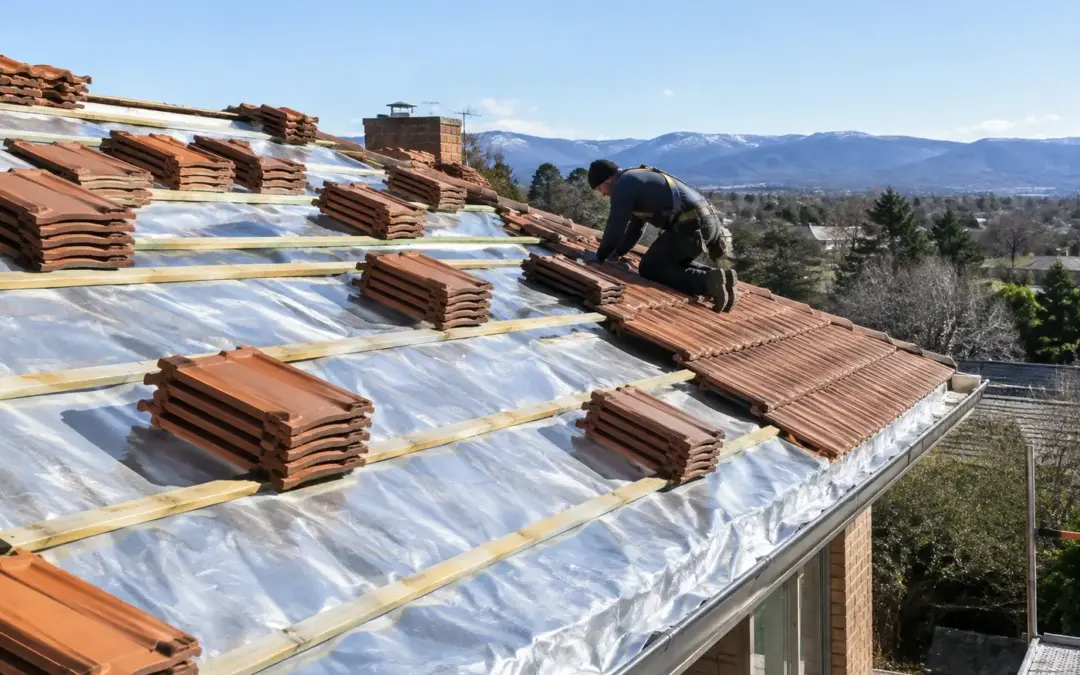
Sarking is a flexible membrane laid over the rafters, underneath the battens that hold your tiles or metal sheets. It’s usually a reinforced foil or a woven plastic fabric. Your tiles or Colorbond do the main job of keeping weather out. Sarking catches whatever gets past them.
And things do get past. Tiles crack, ridge capping lets go, wind pushes rain sideways up under the laps, and fine dust blows in through every gap. When the sarking is installed properly, it runs down the slope and laps over the fascia so anything it catches drains straight into the gutter.
It also blocks draughts and dust, and the foil versions reflect some radiant heat. Those are useful side benefits. The real reason it exists is water.
Plenty of older Canberra roofs were built without it
If your house went up a few decades ago, there’s a decent chance there is nothing under the tiles at all. Stick your head through the manhole on a sunny day. If you can see daylight between the tiles, or look straight up at the underside of the tiles and battens, you have an unsarked roof.
That doesn’t mean the roof is faulty. Tile roofs were designed to shed water on their own, and a tile roof in good repair can go a very long time without sarking causing any trouble. The catch is that the roof has no margin for error. A single slipped or broken tile goes straight to the ceiling. We find this is behind a lot of the mystery leaks people describe to us, and it’s one of the first things we check when someone calls about a roof that only leaks in certain storms.
Some homes do have sarking, but it’s old. Early foil products go brittle, tear along the rafters and sag between them. A sagging section can collect water and dust like a hammock, which defeats the point.
Where sarking genuinely earns its place
Tile roofs that cop wind driven rain
Canberra storms tend to arrive with a lot of wind. Houses on exposed ridges or open blocks get rain driven sideways under the tile laps far more than sheltered homes in leafy streets. If you’ve had more than one leak that appeared and disappeared with the wind direction, sarking is worth a serious look.
Metal roofs on frosty nights
This one surprises people. On a clear Canberra winter night, a metal roof can drop below the temperature of the air in the roof space. Warm, moist air from the house rises, hits the cold underside of the sheets and turns into water. That condensation then drips onto the insulation and ceiling, which can look a lot like a leak. Canberra sits in one of the colder climate zones under the National Construction Code, and the code now pays specific attention to condensation in new roofs for exactly this reason. A suitable membrane or foil blanket under the sheets is the usual answer, and the right time to add it is when the roof is being replaced.
Homes in bushfire prone areas
Anyone who lived through the 2003 fires knows how much of Canberra backs onto bush and grassland. Embers get under roof tiles easily. In designated bushfire prone areas, the Australian bushfire building standard (AS 3959) generally calls for tiled roofs to be fully sarked, along with sealing up gaps where embers could get in. If you’re building, extending or re-roofing in one of those areas, your certifier will tell you what applies to your block. Treat it as a requirement, not an option.
When it isn’t worth chasing
We’d rather be straight about this. If you have an unsarked tile roof that is in good condition and has never leaked, you don’t need to rush out and add sarking. Retrofitting under tiles means taking the tiles and battens off, which is a big job, and on a sound roof the money is usually better spent on maintenance: keeping the tiles intact, the ridge capping pointed and the valleys clear.
The time to add sarking is when the roof is coming off anyway. If you’re weighing up whether your roof needs a restoration or a full replacement, sarking belongs in that conversation. During a replacement it’s a small extra on a job where all the hard work is already being done.
Adding sarking to an existing roof means lifting the roof
There’s no shortcut that does the job properly. Here’s what a retrofit on a tile roof involves:
- The tiles come off and are stacked, and the battens are removed.
- The membrane is rolled out across the rafters, starting at the gutter line, with each run overlapping the one below so water always flows down and out.
- The bottom edge is dressed over the fascia into the gutter.
- Battens go back on (often new ones, if the old ones are tired), then the tiles are relaid, with broken ones swapped out.
On a metal roof, the sheets come off and a membrane or anticondensation blanket goes down before the new sheets are fixed.
You’ll sometimes see sarking stapled between the rafters from inside the roof space. It can help a little with dust and draughts, but it can’t drain into the gutter, so any water it catches simply drips off the bottom edge onto your ceiling. We don’t treat it as a fix for leaks.
Torn or sagging sarking is worth fixing properly
If you have sarking and it’s damaged, small tears can be patched with a compatible sarking tape, usually by lifting the tiles directly above so the repair can be lapped the right way. Taping from underneath leaves the overlap upside down, so water runs straight into the joint.
Where long runs are brittle or the membrane has sagged and is holding water, patching becomes a losing game. That’s often a sign the whole roof is approaching a bigger decision, and it’s worth getting the tiles, battens and sarking assessed together rather than one piece at a time.
Sarking isn’t insulation, and the wrong type can cause problems
Foil sarking reflects radiant heat when there’s an air gap beside it, so it helps a bit in summer. But it’s not a substitute for proper ceiling insulation, and it won’t do much for your winter heating bill on its own.
It also changes how the roof space breathes. An unsarked tile roof is very leaky, which lets heat and moisture escape. Seal it up with a non breathable foil and you can trap both. That’s why vapour permeable membranes, which let moisture vapour out while keeping liquid water from coming in, are now the common choice in cold climates, often paired with some roof ventilation. Which product suits your roof depends on the roofing material, your insulation and how the roof space is ventilated, so it’s worth a proper look rather than grabbing whatever roll is on special.
Get the roof checked before you spend anything
If you’re dealing with a leak you can’t explain, condensation dripping from a metal roof, or a roof that’s due for big work, we can tell you whether sarking is part of the answer or a distraction from the real problem. Have a look at the tile and metal roofing work we do across Canberra and book a free inspection.
Common questions about roof sarking
Does my roof need sarking?
Not every roof does. A sound tile roof that has never leaked can perform fine without it. Sarking is strongly worth having on exposed sites with wind driven rain, under metal roofs where condensation is a risk, and it’s generally required on tiled roofs in designated bushfire prone areas.
Is sarking required under a Colorbond roof?
Not in every case, but in a cold climate like Canberra’s, some form of membrane or foil blanket under metal sheeting is usually the sensible choice to manage condensation. Bushfire requirements and the specifics of your build can also come into it, so check with your roofer or certifier for your block.
Can you add sarking to an existing tiled roof?
Yes, but the tiles and battens have to come off so the membrane can be laid over the rafters and drained into the gutter. Because of that, it usually only makes financial sense during a re-roof or when the roof needs major work anyway.
How do you repair torn roof sarking?
Small tears are patched with compatible sarking tape, ideally from above by lifting the tiles, so the patch laps in the direction water flows. If the sarking is brittle or sagging over large areas, replacing it is more reliable than patching.
Does sarking make a roof hotter?
It can trap heat and moisture if the roof space has no ventilation, which is a common complaint about older foil products. Reflective sarking with an air gap actually reduces radiant heat coming in, and vapour permeable membranes with good ventilation avoid the trapped moisture problem.
What does roof sarking cost?
The membrane itself is a modest part of the bill. The real cost is labour to remove and relay tiles or sheets, which is why adding sarking during a planned replacement costs far less than retrofitting it on its own. Roof size, pitch, access and the condition of the battens all affect the final price.