
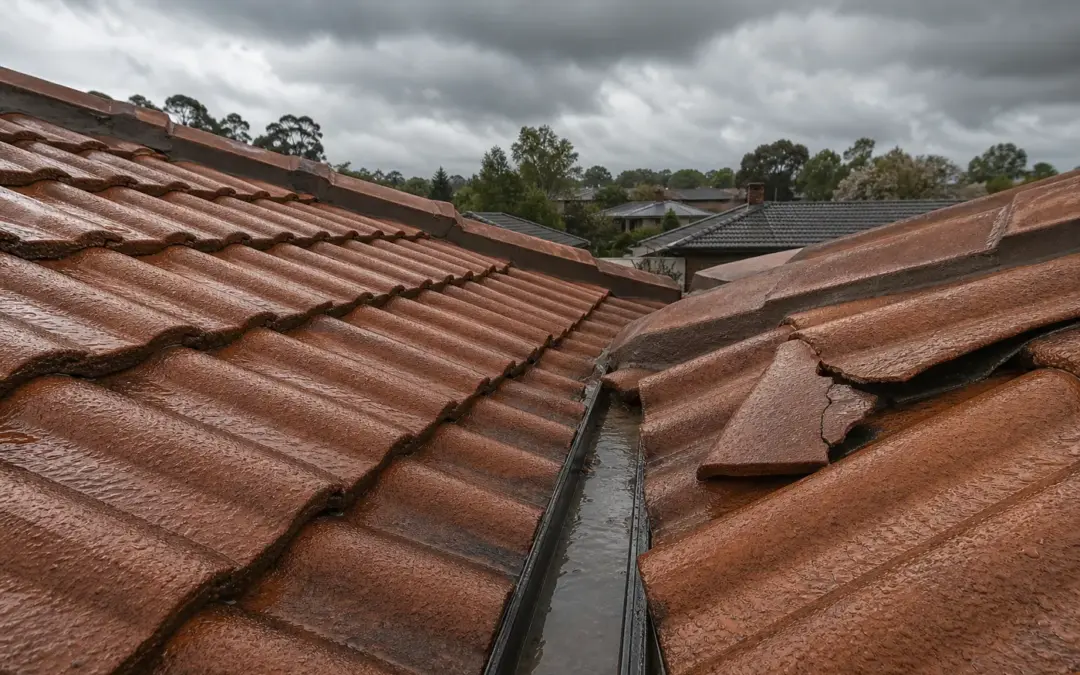
You usually notice it during the first proper downpour of the season. A brown ring creeping across the ceiling, or a slow drip landing in a saucepan someone has left in the hallway. A leak has a way of showing up at the worst moment, normally late on a Sunday with the rain coming in sideways.
We do a fair bit of roof leak repair in Canberra, and the calls tend to sound the same. The rain arrives, water appears inside, and by the time anyone climbs up to look the sky has cleared and nothing seems obviously wrong. That is the tricky part with leaks. Where the water lands inside is almost never directly under where it got in.
The handful of faults behind most leaks
Roofs do not usually fail all over at once. In the homes we look at across Canberra, a leak nearly always comes back to one of these.
- Cracked or slipped tiles. Wind lifts them, a stray branch cracks one, or foot traffic from an earlier job has left a hairline split. It only takes one broken tile to let water through.
- Perished pointing and cracked ridge capping. The mortar that holds the ridge caps along the top of the roof, called pointing, goes brittle with age and starts to crack and drop out. Once it opens up, wind-driven rain gets straight underneath.
- Tired flashing. Flashing is the metal that seals the joins, around chimneys, skylights, vent pipes and where the roof meets a wall. When it rusts, lifts or the sealant behind it gives out, water follows the gap inside.
- Blocked gutters and valleys. Gum leaves fill the gutters and the valleys (the metal channels where two roof slopes meet), water backs up, and instead of running away it pools and creeps back under the roofline. A regular gutter clean to clear the debris heads off a surprising share of leaks.
- An old roof that has simply had enough. On roofs pushing a few decades, the sarking (the foil layer under the tiles that acts as a second line of defence) has often torn or gone to dust, so any water that gets past the tiles has nothing to stop it.
Why it leaks in a storm but stays dry in a shower
This one puzzles people. The roof holds up fine through weeks of light rain, then the moment a real storm rolls through, the ceiling stains. There is a reason for it.
Light rain falls more or less straight down and drains the way the roof was built to shed it. Heavy rain driven by wind hits the roof on an angle and gets pushed sideways and upward, in under the tiles, behind the flashing, over the back of a blocked gutter. A gap that a gentle shower never reaches suddenly has water forced into it. So a roof that only leaks in a proper Canberra storm is not a false alarm. It is telling you exactly where the weak point is, it just needs the wind to show you.
What to do the moment you see water inside
First, move anything valuable out from under it and put a bucket down. If the ceiling is bulging or sagging where water has pooled above the plaster, a gentle pinhole with a screwdriver into the lowest point lets it drain in a controlled way rather than the whole sheet letting go at once. It feels wrong to poke a hole in your own ceiling, but a small drain hole is far cheaper to patch than a collapsed sheet.
Take a couple of photos of the stain and note roughly when it started and what the weather was doing. That matters if you end up making an insurance claim, and it helps us work out where to look. Then leave the roof alone until it is dry. Wet tiles and wet metal are genuinely dangerous underfoot, and Canberra roofs are often steeper than they appear from the ground.
How we find where the water is actually getting in
Because the drip inside can be a metre or more from the real entry point, finding a leak is detective work, not guesswork. We start in the roof cavity where the water trail is often still visible on the timber, then trace it back uphill to the source. From there we check the obvious suspects on top: the tiles, the pointing, the flashings and the valleys. A proper roof leak repair means fixing the thing letting water in, not just sealing the spot on the ceiling where it happened to appear.
Canberra adds its own twist. Our winters bring hard frosts, and water that sits in a hairline crack overnight freezes, expands and works that crack wider a little more each cold snap. A tile or a length of pointing that was almost fine last autumn can be a genuine leak by the time spring rain arrives. It is why we take a close look at the whole roof, not just the one spot, before we call a repair finished.
When a patch stops being the right answer
If your roof is generally sound and one tile has cracked or a section of flashing has rusted, a targeted repair is the sensible fix and it will hold for years. We back our restoration work with a 15 year warranty, so we are not interested in a patch that fails the next time it rains.
There is a point, though, where chasing one leak after another stops making sense. When the pointing is crumbling right along the ridges, the tiles are porous, and you have had three separate leaks in two winters, you are paying for the same afternoon’s access over and over. At that stage it is usually worth pricing a full restoration instead, which sorts the pointing, tiles and coating in one go. We break down what roof restoration costs in Canberra in a separate guide if you want to compare the two.
If you have water coming in now, don’t wait for it to dry out and hope it was a one-off. Send us a photo and roughly where it is showing up, and we will get up there, find the real source and give you a straight answer on whether it is a quick fix or something bigger. Book a roof repair with our Canberra team and we will sort it before the next storm.
Straight answers about roof leaks
What should I do if my roof is leaking?
Contain the water with a bucket, move valuables clear, and if the ceiling is bulging, drain it through a small hole at the lowest point. Photograph the damage for your records and any insurance claim. Then stay off the wet roof and call a roofer to find and fix the source once it is safe.
Is it normal for a roof to leak in heavy rain?
No, a sound roof should stay dry in any weather Canberra throws at it. A leak that only appears in heavy, wind-driven rain simply means the water is being forced into a gap that lighter rain never reaches. It is a real fault worth fixing, not something to live with.
What is the most common cause of roof leaks?
On tile roofs it is usually cracked or slipped tiles and perished pointing along the ridges. On metal roofs it is more often failed flashing, old screws or rust. Blocked gutters and valleys are a frequent culprit on both.
Why does my roof leak sometimes and not every time it rains?
The gap letting water in only gets wet under certain conditions, usually heavy rain on a particular wind direction. Change the angle or the volume of the rain and the water finds the weak point. That on-and-off pattern is normal for a small fault and helps us narrow down where to look.
Is a leaking roof covered by insurance?
Sudden storm damage, like a tile broken by a fallen branch, is often covered, while a leak caused by years of wear and missed maintenance usually is not. It comes down to your policy and the cause. Photos and a roofer’s report on what actually failed will help you make the case either way.
Who do I call for a leaking roof?
A roof plumber or roof repair specialist, rather than a general handyman, since finding the true source takes experience. Look for someone local who knows how Canberra’s frosts and storms affect roofs and who backs their repair with a warranty.