
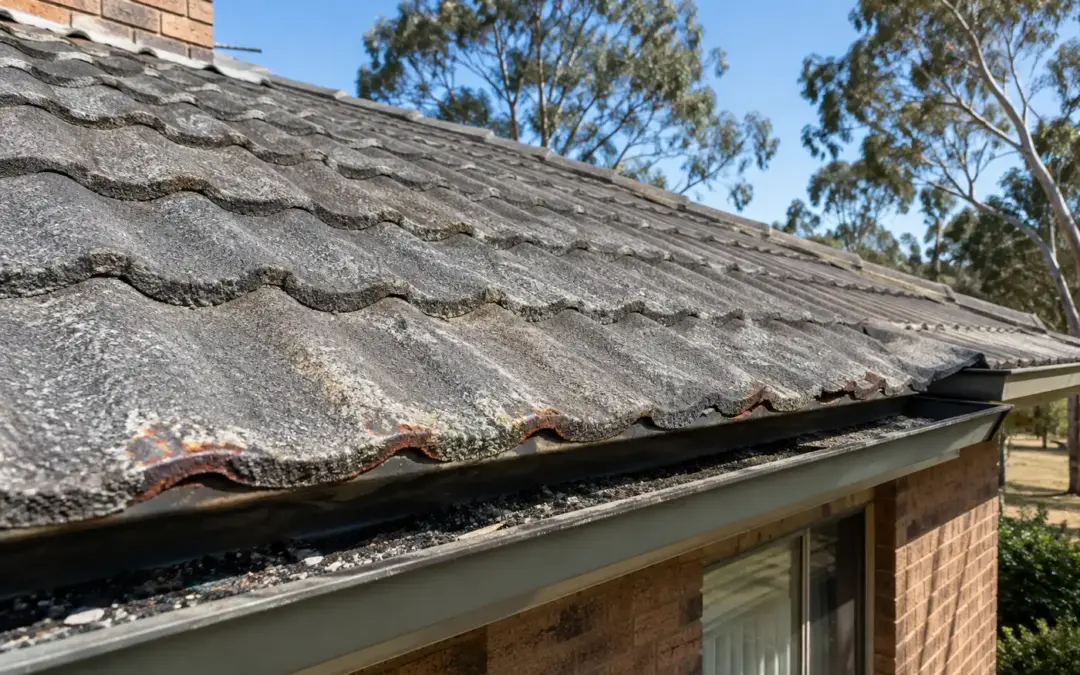
You clean the gutters and find them half full of something that looks like coarse black sand. Then you notice a few roof tiles have a brown tinge along the bottom edge, and one near the TV antenna has a dent the size of a fist. If your house has that scalloped, stone chip roof that was popular decades ago, you almost certainly have decramastic roof tiles, and what you are seeing is the normal way they age.
We get asked about these roofs a lot, usually by people who have just bought an older place and were told by someone at a barbecue that “those tin tiles all need replacing.” Sometimes that is true. Often it is not. This guide covers what decramastic is, how it fails in Canberra conditions, and how to tell whether yours can be restored.
Decramastic is metal pretending to be tile
A decramastic roof is made of pressed steel panels shaped to look like a row of tiles. Each panel is coated in a bitumen adhesive with small stone chips (the granules) pressed into it. The granules give the textured look and protect the bitumen and steel underneath from the sun. The panels are nailed to timber battens and overlap one another, a bit like shingles.
The product came out of New Zealand and was widely used in Australia on houses built through the middle of last century. It is light, which is why it suited many timber framed homes, and in its day it looked like a modern upgrade on plain iron.
The catch is that the whole system depends on that coating staying put. Once the granules go, the bitumen dries and cracks in the sun. Once the bitumen goes, the steel is exposed. Exposed steel rusts.
How these roofs actually fail in Canberra
Canberra is hard on a decramastic roof in a couple of specific ways. We get strong UV for much of the year, cold frosty nights in winter and summer hail storms. Each of these attacks a different weak point.
Granule loss
Sun and temperature swings slowly break down the bitumen, and the chips let go. That gritty material in your gutters and at the bottom of the downpipes is the roof shedding its protective layer. A bit of loss is normal on an older roof. Bare patches where you can see black bitumen or grey steel are the warning sign.
Rust at the laps and nail holes
Water sits longest where one panel overlaps the next, and that is where rust usually starts. Nail fixings are the other weak spot. Over years of heating and cooling, nails can lift slightly, the seal around them breaks and water gets into the hole. A brown streak running down from a nail head tells you this is happening.
Dents and cracked coating
Pressed steel dents. Hail does it, and so do people walking on the roof in the wrong place, such as antenna installers, solar crews and well meaning relatives cleaning gutters. A dent cracks the coating, the granules pop off around it and rust follows. Many of the leaks we trace on these roofs start at a single flattened tile.
Leaks at valleys and flashings
Like any roof, the joins are vulnerable. Valleys, wall flashings and the gaps around chimneys and vents on decramastic roofs were often finished with materials that have long since perished.
Check for asbestos before anyone touches it
Some older bitumen coated imitation tile roofs contain asbestos in the coating. The Australian Government’s asbestos product guide lists this type of roofing, so it is a real possibility and not a scare story. You cannot tell by looking at it.
If your roof is from the era when asbestos products were common, get a sample tested before any cleaning, sanding or removal happens. Pressure cleaning or grinding a coating that contains asbestos is exactly what you do not want. We cover testing, restoring and removal in more detail in our post on whether an asbestos roof in Canberra can be restored.
When restoring makes sense
A decramastic roof is a good candidate for restoration when the steel is still sound. In practice that means rust is limited to surface staining and a handful of panels, the battens underneath are solid, and most of the roof still has a fair covering of granules.
A restoration on this kind of roof is a different job from a concrete tile restoration, and it has to be done gently:
- A low pressure clean. Blasting it at full pressure strips the granules you are trying to keep.
- Replacing badly rusted or crushed panels, and refixing or replacing lifted nails.
- Treating surface rust so it does not keep spreading under the new coating.
- A primer or sealer suited to bitumen, so the old coating does not bleed through and stain the topcoat.
- Repairing or replacing perished flashings and valley sections.
- Two coats of a roof membrane, which also helps lock the remaining granules in place.
One thing that surprises people is how hard it is to find matching replacement panels. The original product is no longer made in the same form. We often take sound panels from a part of the roof you cannot see, such as the back of a hip, and use them to replace damaged ones on the street side. The patched area at the back then gets the closest match available.
The same general approach applies to other metal roofs, and our guide to what a metal roof restoration involves walks through it in more detail. If you want someone to look at your roof and tell you honestly which side of the line it is on, that is what our roof restoration service starts with.
When it is time to replace
Paint does not fix rust that has gone through the steel. If we can push a screwdriver through a panel, or there are rust holes at many laps across the roof, a coating will only hide the problem for a while. The same goes when large areas have lost almost all their granules and the bitumen underneath is cracked and powdery.
Other signs that point towards replacement:
- Soft or rotten battens, found when we lift a few panels
- Leaks in several unrelated spots rather than one clear source
- A roof that has been patched many times with mismatched panels and sealant
- Asbestos in the coating, where restoring it is not the right path
Most decramastic roofs that come off are replaced with Colorbond sheeting. Because the old roof is light, the existing frame was built for a light roof, which suits a metal replacement. Switching to concrete or terracotta tiles is a different story, because they are much heavier, and the frame would need to be checked by someone qualified before that is even considered.
What sets the price either way
We will not give you a per square metre figure here, because on these roofs the number depends on what we find once we are up there. The things that move it most are the size and pitch of the roof, how many panels need replacing and whether we can find matches, the state of the battens and flashings, and whether asbestos testing comes back positive. Access matters too. A single storey house on a flat Kambah block is a quicker setup than a two storey home on a steep Red Hill slope.
The honest comparison is restoration now plus repainting down the track, against replacement now with no coating to maintain. If your roof is borderline, ask whoever quotes it to show you photos of the worst panels so you can see what you are paying to fix.
Walk on it the wrong way and you will pay for it
If you have to go up there yourself, step only on the lower part of each tile shape, where the panel sits over a batten and is supported. The raised middle of the scallop has nothing under it and will crush. Better still, stay off it and look from a ladder at gutter height. Most of what you need to see, such as granule loss, rust at the laps and dents, is visible from there.
If you are seeing grit in the gutters, rust stains or a leak you cannot trace, book a free inspection through our Canberra roof restoration team. We will tell you whether your decramastic roof has years left in it with the right work, or whether the money is better spent on a new roof.
Common questions about decramastic roofs
Can you paint decramastic roof tiles?
Yes, as long as the steel underneath is still sound. The roof needs a gentle clean, rust treatment and a primer that stops the bitumen bleeding through before the topcoats go on. Painting over panels that are rusted through will not stop leaks.
Does decramastic have asbestos?
Some older bitumen coated imitation tile roofs do contain asbestos in the coating, and you cannot tell by looking. Get a sample tested by an accredited laboratory before any cleaning, sanding or removal work starts.
How much does it cost to replace a decramastic roof?
It depends on roof size, pitch, access, the condition of the battens and whether asbestos is present, since that changes how the old roof has to come off. An on site inspection is the only way to get a figure you can rely on. Ask for a written quote that lists removal, disposal and the new roofing separately.
Can you replace a single decramastic tile?
Usually, yes. Damaged panels can be lifted and replaced, though finding an exact match is the hard part. We often take a sound panel from a hidden section of the roof and put a closer match where it shows.
Why are my gutters full of black grit?
That is the stone chip coating coming off your decramastic roof. Some shedding is normal on an older roof, but heavy, ongoing loss means the bitumen is breaking down and the steel will soon be exposed.
Can you walk on a decramastic roof?
Only carefully, and only on the lower part of each tile shape where it is supported by a batten. Stepping on the raised section dents the panel, cracks the coating and starts rust. If you are not sure, stay off it.