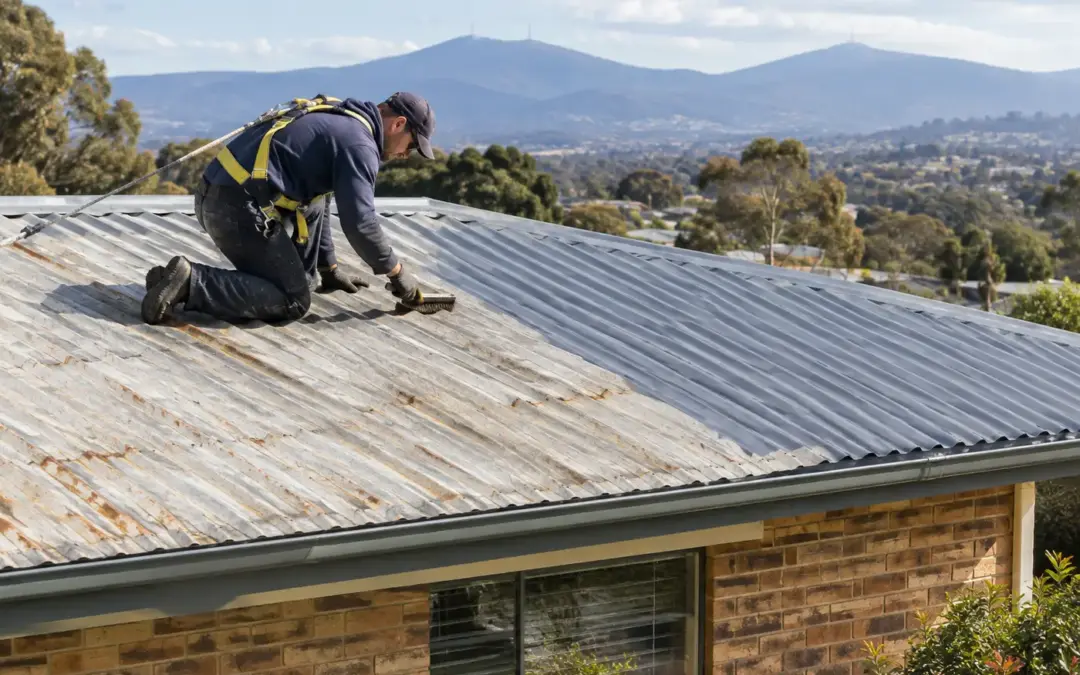
Most calls we get about metal roofs start the same way. Someone runs a hand along the bottom of a downpipe, or brushes against the gutter, and their fingers come away covered in a fine coloured powder. Then they look up and notice the roof that was a crisp deep green or Woodland Grey when they moved in now looks washed out, with a few orange spots near the screws. The question is always the same: can this roof be saved, or is it time for new sheets?
Usually it can be saved. Metal roof restoration in Canberra is a common job for us, and on a roof where the steel is still sound it costs far less than a reroof. But it only works if the prep is done properly. A coat of paint over rust and loose screws just hides the problem for a couple of seasons.
The chalky powder is the first warning, not the last
Colorbond is steel with a metallic coating underneath a factory paint finish. Over years of sun, the top layer of that paint breaks down and turns to powder. Roofers call this chalking. On its own it is cosmetic. The steel underneath is still protected.
The trouble is what tends to come next. Once the paint has thinned, the weak spots on the roof start to show. We see the same ones on almost every metal roof we inspect around Canberra:
- Screw heads, where the original rubber washers have perished and water sits around the fixing
- Laps, the narrow strip where one sheet overlaps the next and moisture gets trapped
- The bottom edge of each sheet where it hangs over the gutter
- Spots under air conditioner drips, TV antennas and old lead flashings
- Anywhere copper pipe runoff or leaf litter sits for long periods
Older galvanised iron roofs, which you still find on plenty of the original cottages in the inner north and inner south, behave a bit differently. They have no paint layer from the factory, so the galvanising itself slowly wears away and surface rust appears across whole sheets rather than in neat spots.
Canberra adds its own pressure. Frosty winter nights followed by bright days mean the steel expands and contracts constantly, which slowly loosens fixings. Cold nights also bring condensation on the underside of the sheets. If you have ever heard what sounds like rain inside the ceiling on a clear frosty morning, that is usually it.
Restore or replace comes down to the steel
The honest test is simple. If the rust is on the surface and the steel underneath is solid, the roof is a restoration candidate. If you can push a screwdriver through a rusted patch, or light shows through from inside the roof space, that sheet is finished and needs to be replaced.
Most roofs we look at sit somewhere in between. Most of the sheets are fine and a handful near the gutter line or around a flue have rusted through. In that case we replace those sheets with matching profile and restore the rest. That mix is often the best value outcome, and it is something a good roofer should offer rather than pushing you straight to a full reroof.
If you are still weighing up materials for the long term, our guide on how Colorbond and tile compare in Canberra conditions covers lifespan and upkeep for each.
What a proper metal roof restoration actually involves
This is where quotes start to differ, so it is worth knowing what should be included. On a typical Colorbond or galvanised roof, the work goes in this order.
1. Inspection and repairs first
Before any cleaning, the roof gets walked and checked sheet by sheet. Rusted through sheets, damaged flashings and failed seals around penetrations (flues, vents, skylights) are marked for repair. Painting over a leak does not fix the leak.
2. Replacing the screws
This step gets skipped more than any other. The original roofing screws on an older roof have usually lost their washers and started to rust. We remove and replace them, or at minimum replace every one that is corroded or loose. New screws with fresh washers seal each fixing point again, and that alone stops a lot of slow leaks.
3. Cleaning
The roof is washed to remove chalking, dirt, moss and lichen. Paint will not grip a powdery surface, so this has to be thorough. On metal we use a controlled pressure so we clean the surface without forcing water up under the laps and flashings.
4. Treating the rust
Every rust spot is wire brushed or ground back to bare, solid metal, then treated so the corrosion does not keep spreading under the new coating. This is slow, fiddly work and it is the part that decides how long the restoration lasts.
5. Primer, then topcoats
Bare metal and treated areas get a primer made for the specific base metal, since galvanised steel and Colorbond each need the right one to bond properly. Then the whole roof gets its topcoats of a paint made for metal roofing. Heat reflective finishes are worth asking about if your house bakes in summer.
We cover colour choices and coating options in more depth in our article on whether painting your roof pays off. The short version: painting is the final stage of a restoration, not a replacement for steps one to four.
Canberra weather decides the timing
Paint needs a dry surface, a few hours above the dew point, and time to cure before the temperature drops. In a Canberra winter that window can be very short. Frost on the roof until mid morning and dew settling again by late afternoon leaves little time to work, and paint applied to a damp or near freezing surface can fail early.
For that reason we schedule most metal roof coatings from spring through to autumn. Inspections, screw replacement and sheet repairs can happen any time of year, so there is no need to wait until October to find out what your roof needs. Getting it assessed in winter means you can be first in line once the weather warms up.
Signs your metal roof needs attention now
Some roofs can wait a season. Others should not. Call someone sooner rather than later if you notice:
- Rust that has spread from around the screws into the surrounding sheet
- Water stains on ceilings near external walls, often a sign of rusted sheet ends or gutter overflow
- Screws you can see sitting proud of the sheet or missing altogether
- Flashings lifting or flapping in wind
- Paint peeling off in flakes rather than just fading
Fading and chalking on their own are not urgent. Rust that has started to bubble or flake is, because every winter of wet and frost makes the repair bigger.
Getting your roof looked at
The only way to know whether your metal roof is a restoration job, a partial resheet or a full replacement is to have someone get up and look at the steel. We offer a free inspection and will tell you plainly which group your roof falls into, including when it is not worth restoring. If you want to talk it through, our Canberra roof restoration team can arrange a time that suits you.
Common questions about metal roof restoration
Can Colorbond roofs be restored?
Yes, as long as the steel itself is still sound. Faded, chalky Colorbond with surface rust is a good candidate for cleaning, rust treatment, new screws and recoating. Sheets that have rusted right through need to be replaced, but those can usually be swapped individually while the rest of the roof is restored.
What is the biggest problem with metal roofs?
Rust at the weak points: screw holes, sheet overlaps and the bottom edges over the gutter. These spots hold moisture longer than the rest of the roof. In Canberra, constant expansion and contraction between frosty nights and warm days also loosens fixings over time, which lets more water in.
How do you rejuvenate a faded metal roof?
Clean it thoroughly to remove chalking and grime, treat any rust back to solid metal, replace failed screws, then apply a primer suited to the base metal and topcoats designed for metal roofing. Skipping the cleaning or rust treatment is the most common reason a repaint peels early.
What type of coating is best for a metal roof?
A paint system made specifically for metal roofing, applied over a primer that matches the base metal. Galvanised iron and Colorbond each need the correct primer for the topcoat to bond. Heat reflective topcoats are a good option for homes that get hot in summer.
How do you get rid of oxidation on a metal roof?
The powdery oxidation on painted Colorbond, called chalking, comes off with a thorough wash. Rust is a different matter. It needs to be wire brushed or ground back to clean metal and treated before any coating goes on, otherwise it keeps spreading underneath the new paint.
Can you paint a metal roof in winter in Canberra?
It is possible on the right day, but risky. Frost and dew leave a short daily window, and paint applied to a damp or very cold surface may not cure properly. We prefer to coat metal roofs from spring to autumn and use winter for inspections and repairs.