
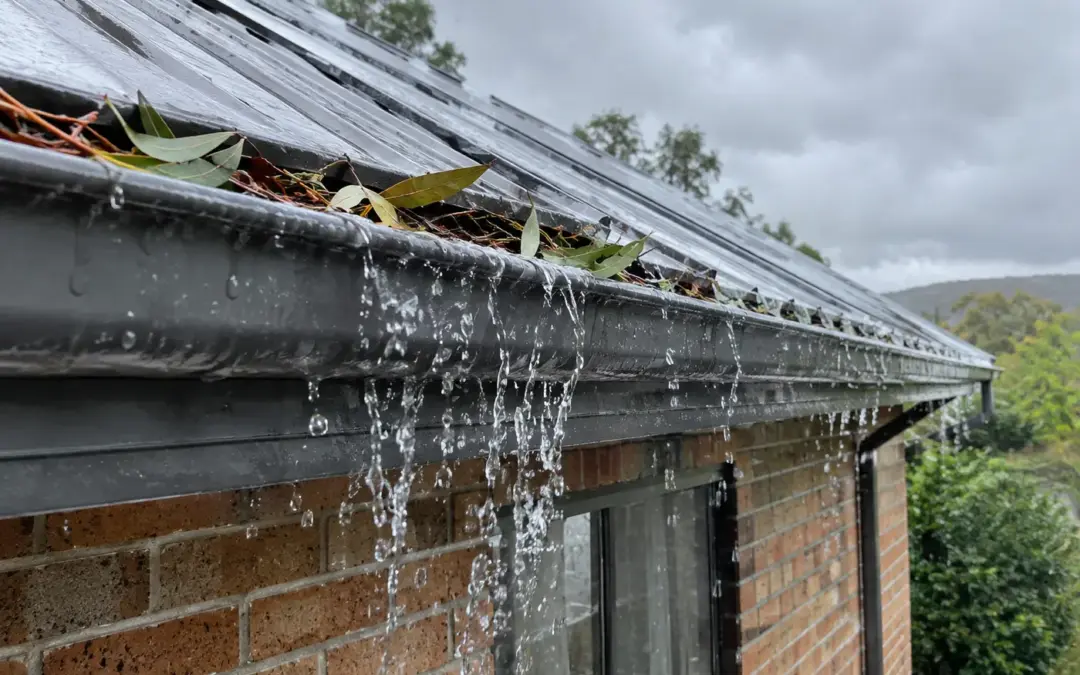
It is a summer afternoon, a storm rolls in over the Brindabellas, and within ten minutes there is a sheet of water coming off the front of your gutter like a waterfall. The gutters were cleaned in autumn. So why is this happening?
We get this call a lot from November onwards. Gutters overflowing in heavy rain is one of the most common things Canberra homeowners ask us about, and the cause is not always leaves. Sometimes it is. Often it is something about how the water gets in, travels along, or gets out of the gutter. Working out which one you have tells you whether the fix is a job you can do yourself with a ladder or something a roof plumber needs to sort.
Some overflow in a cloudburst is normal. Regular overflow is not
Every gutter has a limit. In a genuinely violent downpour, the kind that dumps hail and turns the street into a creek for twenty minutes, almost any domestic gutter can spill for a short burst. Many newer homes also have slotted gutters, which have small slots along the front face. Those are designed to let water out the front, away from the house, if the gutter fills. Water from the slots is the system doing its job.
What should worry you is overflow in ordinary heavy rain, overflow at the same spot every time, or water spilling over the back edge of the gutter towards the fascia and eaves. Water going that way can end up inside the wall cavity or the eave lining, and that is where the real damage happens.
Stand outside in the rain for five minutes
It sounds odd, but watching the gutter while it rains is the best diagnostic tool you have. Grab an umbrella and note three things: where the water is coming over, whether it is spilling over the front or the back, and whether the nearest downpipe is actually running hard. Those three answers point to the cause far more reliably than guessing from the ground on a dry day.
The five causes we find most often
1. A blockage, usually at the outlet
Leaves are still the number one culprit. Canberra’s eucalypts drop leaves, bark and gumnuts all year round, and suburbs with big established street trees, like much of the inner north and inner south, fill gutters fast. The thing people miss is that the blockage is often not along the gutter at all. It is a wad of leaves sitting right over the downpipe outlet, or lodged further down inside the downpipe itself. The gutter looks fairly clear from a ladder, yet nothing can drain.
If the overflow is worst right next to a downpipe and that downpipe is barely trickling, this is almost certainly your problem. Our guide on how often to clean gutters in Canberra covers how to set a sensible cleaning routine for your trees.
2. The gutter has lost its fall
Gutters need a slight slope (the “fall”) towards each downpipe so water runs to the outlet instead of sitting still. Over the years brackets loosen, fascia boards move, and the odd ladder gets leaned on the gutter. The result is a sag, or a section that slopes the wrong way. Water pools in the low spot and overflows there first.
Tell-tale signs: standing water in the gutter a day or two after rain, a line of sludge or rust at the pooling point, and overflow at a spot nowhere near a downpipe. Pooling water also rusts steel gutters from the inside, so a fall problem tends to become a leak problem in time.
3. Too much roof feeding too little gutter
This one surprises people. Some houses simply have too few downpipes, or gutters that are too small, for the size of the roof draining into them. A long run of gutter with one downpipe at the far end has to carry the whole roof’s water past every metre of its length. On older Canberra homes, and on extensions where the new roof was tied into an old gutter, we often find the system was never sized for a big summer storm.
If the gutter is clean, falls correctly, and still overflows along most of its length, capacity is the likely issue. The fix is usually an extra downpipe, a larger outlet, or in some cases a bigger gutter profile.
4. Valleys and steep roofs overshooting the gutter
Where two roof slopes meet, the valley channels a concentrated stream of water straight into one corner of the gutter. On steeper roofs that water arrives fast enough to jump clean over the front edge. If your overflow is always at an internal corner below a valley, that is the cause, not a blockage. A valley splash guard or a small modification at the corner usually sorts it. If the valley itself is rusted or leaking, our post on roof valley repairs explains what is involved.
5. Water getting behind the gutter
Sometimes what looks like overflow is actually water running behind the gutter. Tiles or roof sheets that stop short of the gutter, missing gutter apron flashing, or a gutter mounted too low on the fascia can all let water drip down the back. You will see it as staining on the fascia or water dripping from the eaves when the front of the gutter is not spilling at all. This is the version most likely to cause rot and damp, so do not leave it.
What overflowing gutters actually damage
One of the questions people ask most is how urgent this is. A one-off spill in a freak storm, not very. Repeated overflow, especially over the back edge, is a different story. Over time we see it cause:
- rotting fascia boards and swollen eave linings
- water in the wall cavity, which can show up as damp patches or bubbling paint inside
- soil washed out against the slab, and water pooling near footings
- rust starting at the pooling points in steel gutters
So yes, leaking and overflowing gutters can cause damp. The water has to go somewhere, and if it is not going down the downpipe it is usually going into the house structure or the ground beside it.
What you can safely check yourself
If you are comfortable on a ladder and the roof is single storey, you can clear leaves from the gutter and outlets and run a garden hose into the high end to watch where the water goes. Watch whether it reaches the downpipe and whether the downpipe empties freely at the bottom. A hose test on a dry day shows up sags and blocked outlets well.
Leave anything on a two storey roof, anything involving walking on tiles or sheets, and anything that needs gutters re-hung or re-falled to someone with the right gear. Most gutter falls we hear about happen during exactly this kind of quick job.
When it needs a roofer
Call someone in if the gutter is clean and still overflows, if water is getting behind the gutter, if you can see sagging, rust holes or pulled brackets, or if a downpipe is blocked below ground level. These need the gutter re-hung, outlets or downpipes added, or sections replaced. Our team handles gutter repairs across Canberra, from re-falling a sagging run to adding a downpipe where the roof simply has too much water for one outlet. If the gutters are rusted through end to end, a repair may not be worth it, and replacement becomes the honest recommendation.
Not sure which of the five causes you have? Get in touch to book a free inspection. We will look at the gutters, the downpipes and the roof feeding them, then tell you plainly what is causing the overflow and what it will take to fix it.
Common questions about overflowing gutters
Is it normal for gutters to overflow in heavy rain?
A brief spill in an extreme downpour can happen with almost any domestic gutter, and slotted gutters are designed to release water out the front. Overflow in ordinary heavy rain, or overflow at the same spot every time, points to a blockage, poor fall or a capacity problem that should be fixed.
Why is water pooling in my gutters?
Pooling almost always means the gutter has lost its slope towards the downpipe, usually from loose brackets or a fascia that has moved. It can also mean the outlet is partly blocked. Pooled water speeds up rust in steel gutters, so it is worth getting the fall corrected.
What happens if your gutters overflow?
Water that spills over the back of the gutter can rot fascia boards, soak eave linings and get into wall cavities. Water spilling over the front lands beside the house and can pool near the slab or footings. Either way, regular overflow leads to repairs that cost more than fixing the gutter.
How urgent is a leaking or overflowing gutter?
If water is getting behind the gutter or showing up as damp inside, treat it as urgent and have it looked at before the next big storm. If it only spills out the front during the heaviest downpours, it is less pressing, but worth checking before summer.
Can gutter guards stop overflow in heavy rain?
Gutter guards help when the overflow is caused by leaves blocking the gutter and outlets. They will not fix a gutter that has lost its fall, an undersized system, or water shooting out of a valley. Work out the cause first, then decide whether guards are part of the fix.
My gutters were just cleaned but still overflow. Why?
Check the downpipe. A blockage further down the pipe, or in the underground stormwater line, stops the gutter draining even when the gutter itself is spotless. If the downpipe runs freely, the gutter is probably sagging or too small for the roof area feeding it.