
It usually starts with a brown ring on the ceiling, often in a hallway or bedroom, and often near the corner of an L-shaped house. It only shows up after a proper downpour. Light rain does nothing. You get a roofer up there expecting a cracked tile, and they come down talking about the valley instead.
That’s the most common way we find valley problems on Canberra homes. Roof valley repair is one of those jobs most people have never heard of until they need it, so here’s what a valley actually does, how it fails, and how to tell a quick fix from a bigger job.
The valley takes more water than any other part of your roof
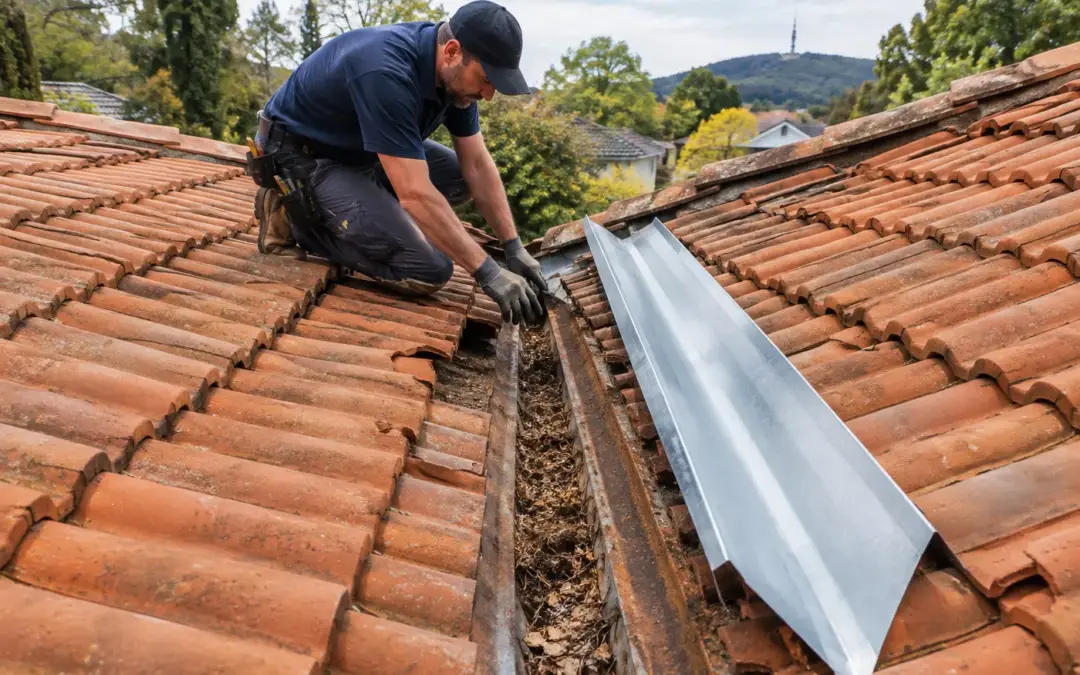
A valley is the internal angle where two roof slopes meet, like the inside fold of an open book. Every time it rains, water from both slopes funnels into that one channel and runs down to the gutter. On a tile roof the channel is a metal tray called a valley iron, with the tiles on each side cut at an angle and laid over its edges. On a Colorbond or metal roof it is a formed valley gutter or flashing that the sheets sit over.
Because it carries the runoff from two roof faces at once, the valley sees more water, more debris and more wear than a flat stretch of tiles. When something goes wrong there, it goes wrong in heavy rain first, which is exactly why those leaks seem to come and go.
Five ways valleys fail on Canberra roofs
Most of the valley leaks we trace come down to one of these, and on older roofs it’s often two or three at once.
Rust in old galvanised valley irons
Plenty of older Canberra houses still have their original galvanised steel valleys. The zinc coating wears away over decades, and once it’s gone the steel rusts from the centre of the channel outward, because that’s where water and wet leaf litter sit longest. You can’t patch your way out of a valley that has rusted through. It needs replacing.
Leaves and debris damming the channel
Canberra’s street trees are lovely in autumn and hard on roofs. Leaves, gumnuts and twigs collect in valleys, hold moisture against the metal and build little dams. In a summer storm, water backs up behind the debris and spills sideways over the edge of the valley iron, straight under the tiles and into the roof space.
Cracked bedding and pointing on the cut tiles
On many tile roofs, the cut tiles along the valley are held in place with mortar bedding and finished with a pointing compound. Over years of hot summers and frosty winter mornings, that mortar cracks and lets go. Loose tiles can then shift or slide, opening gaps where wind can drive rain in.
Tiles cut too short or a valley that’s too narrow
This one is a workmanship fault, not wear and tear. If the tiles were cut so they barely overlap the valley iron, or the valley is too narrow for the size of the roof feeding it, heavy rain can overshoot or overflow it. The roof may have leaked on and off since the day it went on.
Old patch jobs and silicone
We see a lot of valleys with a blob of silicone or a strip of tape where someone tried a quick fix. Silicone can actually make things worse in a valley, because it traps water against the metal and blocks the channels water is supposed to run along. It also has to be scraped off before the real repair can start.
Signs it’s the valley and not something else
Leaks travel. Water can run along a batten or rafter a fair way before it drips onto the ceiling, so the stain isn’t always directly under the problem. Still, a few clues point strongly at the valley:
- The stain sits near an internal corner of the house, or below where two roof sections join
- It only leaks in heavy or wind driven rain
- From the ground you can see rust, a dark line of moss or a pile of leaves along the valley
- Tiles beside the valley look out of line, or there are bits of broken mortar in the gutter below it
- Water pours over the gutter at the bottom of the valley in a storm
If none of that fits, our guide to tracking down why a Canberra roof leaks covers the other usual suspects. Valleys are closely related to flashings, the metal strips that seal around chimneys, walls and skylights, and the two often get confused. Our post on spotting failed roof flashing explains the difference.
Repair or replace: what the fix actually involves
The good news is that plenty of valley leaks don’t need new metal. The honest news is that some do, and resealing a valley that’s rusted through just delays the job.
When a clean out and repair is enough
If the valley iron is sound, the fix is usually some combination of clearing the debris, straightening or replacing any slipped or broken tiles, and re-bedding and repointing the cut tiles along the valley. On a metal roof it might mean resealing laps and fixings. This is a smaller job, and on a roof in otherwise decent condition it can buy many years.
When the valley iron has to come out
Rust holes, metal that has gone thin and flaky, or a valley that was too narrow from the start all mean replacement. We lift the tiles on both sides, remove the old iron, check the battens and sarking underneath, and lay a new valley in Colorbond or Zincalume. The tiles then go back down, recut where needed so they overlap the new valley properly, and get re-bedded and pointed. You can read more about how we handle valley iron replacement on Canberra homes.
One thing that surprises people: if one valley on a roof has rusted through, the others are usually the same age and not far behind. It often makes sense to replace them together while the scaffolding or safety gear is already set up.
What changes the price of a valley repair
Every valley job is quoted after someone has been up on the roof, because the variables make a big difference. The main ones are:
- How long the valley is, and how many there are
- Whether it’s a reseal and repoint or a full valley iron replacement
- The roof pitch and height, which decide what safety equipment is needed
- Tile type, since older terracotta can be brittle and some tiles break when lifted
- Whether battens or sarking under the valley are damaged and need work too
A valley replacement on a single storey roof with one short valley is a very different job from a steep two storey roof with four long ones. That’s why we’d rather look first than throw a number at you over the phone.
Keeping a new valley clear for longer
Once a valley is fixed, the main enemy is debris. If you have large trees over the roof, clearing the valleys and gutters before winter and again before the storm season catches most problems early. Valley guard, a mesh that sits over the valley and keeps leaves out while letting water through, is worth considering on heavily treed blocks. It isn’t a substitute for an occasional check, but it does cut down how quickly leaf litter builds up.
If you’re already thinking about a full restoration, the valleys should be part of that conversation. There’s little point painting a roof with a valley that’s halfway to rusting through.
Get the valley checked before the next big storm
If you’ve got a stain near an internal corner or a valley you can see is rusting, book a free inspection and we’ll get up there, find where the water is getting in and tell you straight whether it needs a repair or a replacement. Our roof valley repair and replacement service covers tile and metal roofs right across Canberra.
Common questions about roof valley repairs
How much does roof valley repair cost in Canberra?
It depends mostly on whether the valley needs a reseal and repoint or a full valley iron replacement, plus the length of the valley, the roof height and the tile type. A simple repair on an accessible roof is a much smaller job than replacing several long valleys on a steep roof. The only reliable way to get a real figure is an inspection and a written quote.
Can I fix a leaking roof valley with silicone?
We don’t recommend it. Silicone doesn’t stop rust, it traps moisture against the metal, and it can block the channels that carry water down the valley. It also has to be removed before a proper repair, so it often adds to the bill rather than saving money.
Why does my roof only leak in heavy rain?
Heavy rain is when valleys and gutters run at full capacity. A valley that copes with a light shower can overflow in a downpour if it’s narrow, partly blocked with leaves, or has tiles cut too short to overlap it properly. Wind driven rain can also push water sideways under tiles at the valley edge.
Is it cheaper to repair or replace a roof valley?
A repair is cheaper on the day, and if the valley iron is still in good condition it’s the right call. If the metal has rusted through or gone thin, a repair won’t last, and you’ll end up paying for the replacement anyway on top of the patch.
How long does a valley replacement take?
Most single valley replacements on a straightforward roof are done within a day, weather permitting. Steeper roofs, multiple valleys, brittle tiles or damaged battens underneath can stretch that out, and your roofer should tell you this when they quote.
How many quotes should I get for a roof valley repair?
Two or three is sensible. More useful than the number of quotes is what’s in them: check each one says whether it’s a repair or a full replacement, what metal the new valley will be, and whether re-bedding and repointing of the tiles is included.