
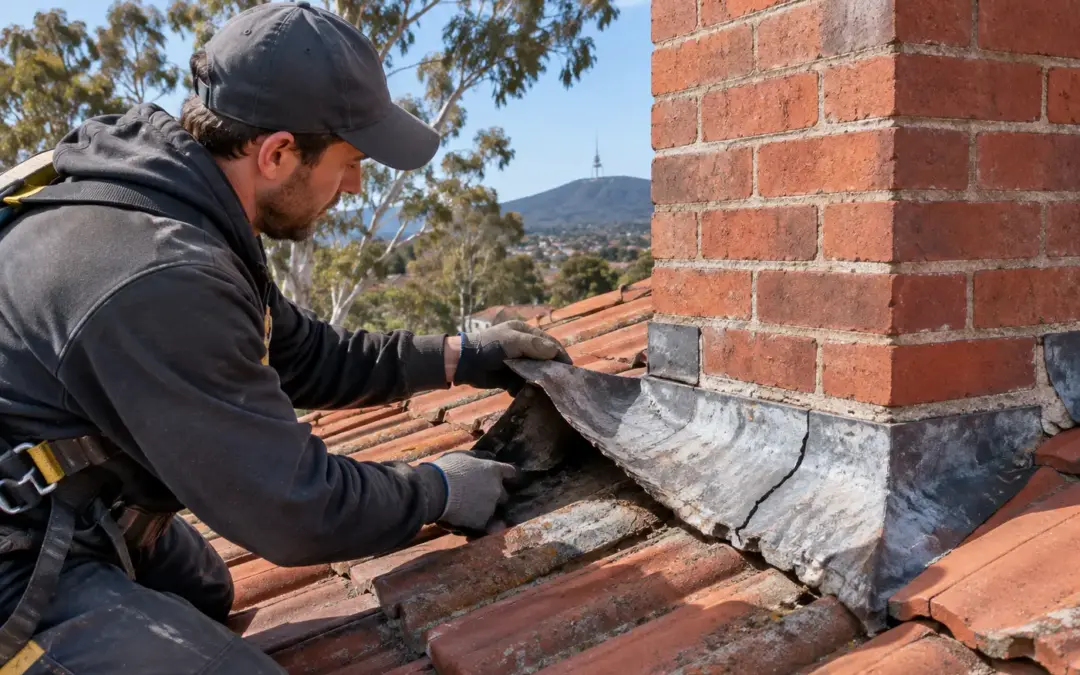
The call usually goes like this. A brown stain has appeared on the ceiling beside the chimney, or there is a drip near the skylight every time a storm rolls in from the west. The owner assumes the roof is shot. More often than not we climb up and find the tiles or sheets are fine, and the real culprit is the flashing. Roof flashing repair in Canberra is one of the most common jobs we do, and it is also one of the most misunderstood, because the failed part is small, easy to miss and often hidden under a smear of old silicone.
This post covers what flashing does, how to tell it has failed, which fixes last and which ones just buy you a season.
Flashing is the joint, not the roof
Flashing is the strip of metal (or on older tile roofs, lead or a flexible rubber-type material) that seals the gaps where your roof meets something else. A roof surface sheds water well on its own. The trouble spots are the places where it stops: against a wall, around a chimney, at a skylight, where a flue or vent pipe pokes through, and along the valleys where two roof slopes meet.
You will hear a few names for the different pieces:
- Apron flashing runs along the bottom edge where a roof meets a wall below it
- Step and counter flashing climb the sides of a chimney or wall in overlapping pieces
- Valley irons line the channel between two roof slopes
- Pipe and flue collars seal around anything that penetrates the roof
Each one is a joint between two materials that move differently. That is exactly why they fail first.
Canberra weather is hard on flashing
Our climate works flashing harder than most of the coast. Winter nights drop well below freezing, and summer afternoons on a dark roof get very hot. Metal expands and contracts through that swing every day, while the brick chimney or rendered wall it is fixed to barely moves. Over years, fixings loosen and the seal between the two opens up.
UV does the rest. A lot of flashing we see was sealed with a bead of silicone or cheap roof sealant, and in Canberra sun that goes hard, shrinks and pulls away from the surface. It still looks like it is there. It just is not doing anything.
Then there are the storms. Strong westerly winds can lift a loose flashing edge, and hail can dent or split it. If your problem started straight after a big storm, photograph the damage before anything is moved or repaired, because your insurer will want to see it.
Six signs your flashing has let go
Some of these you can check from the ground or from inside the ceiling space with a torch. Please do not climb onto the roof to look. Tiles crack underfoot and metal roofs are slippery with even a bit of dew or frost.
- Ceiling stains that sit close to a chimney, skylight, wall junction or vent, rather than out in the middle of a room
- A leak that only shows up in wind driven rain, not in steady drizzle
- Visible gaps, lifted edges or flashing that has pulled out of the mortar joint in a chimney
- Rust spots or holes along valley irons, especially where leaves sit
- Old sealant that is cracked, peeling or has been layered on three or four times
- Damp or mouldy timber in the roof space right under one of those junctions
That last point about repeated sealant is worth dwelling on. When we see layer after layer of silicone on one spot, it tells us someone has patched a leak several times without fixing why it was leaking. Water is patient. It finds the next gap.
Flashing is only one cause of leaks, of course. If the stain is nowhere near a junction, our post on why Canberra roofs leak walks through the other usual suspects, like cracked tiles, rusted sheets and blocked gutters.
Sealant is a patch. Replacement is a repair.
Here is the honest version. A dab of sealant on a small gap in otherwise sound flashing can be a reasonable short term fix. It is cheap, quick and sometimes it is the right call while you plan bigger work. But it is not a repair, and anyone who sells it to you as permanent is not doing you a favour.
A proper flashing repair usually means one of these:
Refixing and resealing. If the flashing itself is in good shape but has worked loose, we lift it, clean the surfaces back, refix it properly and reseal with a product designed for roofing. On chimneys, that often means raking out the mortar joint and re-dressing the flashing into it so it cannot peel away.
Replacing a section. Rusted valley irons, split lead and flashing that has been bent out of shape by wind or foot traffic generally need to come out. Patching over rust just traps moisture underneath and speeds things up.
Replacing the lot at one junction. Where the original flashing was badly designed, too short, the wrong material, or not lapped the right way, we would rather replace it once than come back every winter. This is common on older chimneys and on extensions where the new roof was tied into the old one in a hurry.
Whichever it is, the material has to suit the roof. Mixing the wrong metals causes corrosion, and some metals react badly with certain roof sheets. That is one reason we steer people away from grabbing any flashing off the shelf. Our roof flashing replacement service matches the flashing to what is already on your roof, whether that is tile, Colorbond or older galvanised iron.
Tile roofs and metal roofs fail in different spots
On the tile roofs we look at, the weak points are mostly around chimneys and where the roof meets a wall. Older homes often have lead flashing dressed over the tiles, and after decades it can split, lift or get disturbed. The ridge capping and bedding on the same roof are often due for attention too, which is why we check them together. If that sounds familiar, our piece on ridge capping and repointing explains what to look for.
Metal roofs are a bit different. Here the flashings are usually folded Colorbond or zincalume, screwed down along the sheet ribs. The problems we find are loose or rusted screws, flashing cut too short so water blows under it, and valley irons corroding where wet leaves have sat against them for years. Flashing on metal roofs also needs to be fixed so it can move with the sheets. If it is locked down too tightly, the fixings work loose over a few hot summers.
Can you fix flashing yourself?
You can buy flexible flashing and sealant at any hardware store, and plenty of people give it a go. For a garden shed, fair enough. On a house, we would suggest caution for three reasons. Working at height is genuinely dangerous. Most flashing leaks come from how the flashing was lapped and fixed, not from a visible hole, so sealing the obvious gap often misses the real entry point. And a DIY patch can hide the problem until timber in the roof space has started to rot.
If you want to do something while you wait for help, the useful jobs are safe ones: put a bucket under the drip, move anything valuable away, take photos of the stain and note which way the wind was blowing when it leaked. That information helps us find the source quickly.
Get a proper look before it spreads
Flashing problems do not fix themselves, and they tend to get worse right when you need the roof most, in a winter storm. We are tile and metal roofing specialists, and we offer a free inspection so you know exactly which joint has failed and what it will take to fix it properly. If you have a stain near a chimney, wall or skylight, book in a flashing check with our team and we will tell you straight whether it needs a reseal or a replacement.
Common questions about roof flashing
How do you repair roof flashing?
It depends on what failed. Sound flashing that has worked loose is lifted, cleaned, refixed and resealed. Flashing that is rusted, split or badly designed is cut out and replaced with material that suits the roof. A bead of sealant on its own is only a temporary patch.
Can I replace flashing myself?
On a shed, possibly. On a house we do not recommend it. Roof work is risky, and most flashing leaks come from how the pieces are lapped and fixed, which is hard to judge without experience. A missed entry point can let water into the roof timbers for months before you notice.
My roof flashing is leaking. How can I fix it?
In the short term, catch the water, protect your belongings and photograph the stain. Then get the flashing inspected so you know whether it can be refixed or needs replacing. Adding more sealant over old sealant rarely stops the leak for long.
What is the lifespan of roof flashing?
It varies a lot with the material, how well it was installed and how exposed it is. In Canberra, the sealant used on flashing usually gives up well before the metal does, because of the UV and the big daily temperature swings. A regular inspection is the best way to catch it early.
Can you replace flashing without replacing the roof?
Yes, and that is what we do most of the time. Flashing is a separate component, so we can remove and replace it at a chimney, wall or valley without touching the rest of the roof. If the roof is due for restoration anyway, it often makes sense to do both together.
Should roofers replace flashing during a restoration?
They should at least check every piece. Where the flashing is sound, it can be cleaned, refixed and resealed. Where it is rusted or damaged, replacing it during the restoration saves a second trip up the ladder later.