
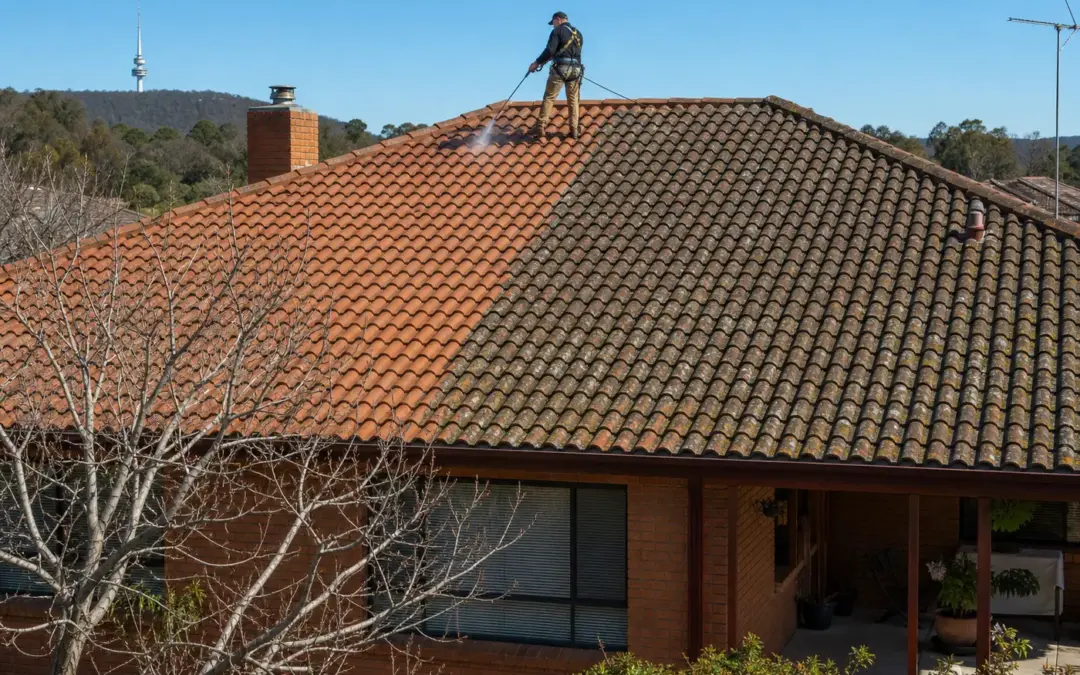
You have been up the ladder, or a roofer has, and the news is not great. Tiles faded, a couple cracked, the ridge capping crumbling, and now you are holding two very different quotes. One says restore. The other says replace, for several times the money. So which one does your roof actually need?
Working out roof restoration versus replacement in Canberra usually comes down to one thing, and it is not the year your house was built. It is the condition of the roof underneath the tired surface. We look at a lot of roofs across the ACT, and most of the time the right answer is clear within the first ten minutes on the roof. The trick is knowing what a roofer is actually looking at.
Restore and replace are two different jobs
A restoration keeps your existing roof. We clean off the years of grime and moss, replace any broken tiles, re-bed and re-point the ridge capping so it stops letting water in, and then seal and re-coat the whole surface. The bones of the roof stay where they are. You end up with a roof that looks new and sheds water properly again.
A replacement is a bigger job. The old roof comes off, and depending on its state that can mean tiles, ridges, pointing, and sometimes the sarking and battens underneath. A new roof goes on in its place, often a switch from old tiles to lighter Colorbond steel. It costs more, takes longer, and creates a lot more mess. In return you get a brand new roof with a fresh, full lifespan ahead of it.
It comes down to condition, not age
People assume an old roof needs replacing and a newer one just needs a tidy up. It rarely works out that neatly. We see 40 year old tile roofs that are structurally sound and restore beautifully, and we see much younger roofs that were poorly laid and are past saving.
What we are really checking is whether the roof is still doing its structural job. Are the tiles themselves sound, or are they flaking and porous? Is the framework straight, or is it sagging? Is the problem all on the surface, or has water already been getting into the timber for years? If the structure is good and the trouble is cosmetic and superficial, restoration wins almost every time. If you are dealing with widespread rot, failed battens, or a roof that has been patched to death, replacement is the honest answer. And sometimes it is neither big job. Sometimes it really is just one specific roof leak that needs tracking down and fixing.
When a restoration is the sensible choice
Restoration tends to be the right call when your roof is tired rather than broken. The common signs we see on Canberra homes that point toward a restore:
- The tiles are faded, dirty or growing moss, but they are not cracked across the board.
- The ridge capping is loose or the pointing is crumbling, which is one of the most common causes of leaks here.
- You have the occasional slipped or broken tile, not dozens.
- The roof is sound underneath and you simply want it watertight and looking sharp again, often before selling.
In those cases a full roof restoration gives you most of the benefit of a new roof for a fraction of the outlay. Because we back our work with a 15 year warranty, you also know it is not a quick coat of paint that fades in two winters.
When replacement is the honest answer
There is no point restoring a roof that is failing from the inside. We will tell you to replace when the tiles themselves have gone brittle and porous, when there is water damage or rot in the battens and sarking, or when a roof has been repaired so many times that another patch is throwing good money after bad. Storm and hail damage that has cracked a large share of the tiles can tip a roof into this bracket too.
A full roof replacement costs more up front, but on a roof in that condition it is the cheaper option over ten years. Restoring a roof that should have been replaced just means paying twice.
What the two options cost, roughly
The honest short version: a restoration is usually a fraction of the cost of a full replacement on the same house. Replacement carries the labour of stripping the old roof, disposal, and all new materials, so it lands at a multiple of the restore price rather than a little more.
That gap is exactly why the decision matters. Spend on a restoration when replacement was needed and you have wasted it. Replace a roof that only needed a restore and you have spent thousands you did not have to. We have written up what a restoration actually costs in Canberra if you want real local figures rather than a national average.
What Canberra’s weather does to the decision
Our climate is hard on roofs in a specific way. The frosty winters mean water gets into hairline cracks in old tiles and pointing, freezes overnight, and slowly splits them open. The hot, dry summers then bake the surface and fade coatings faster than a milder coastal climate would. Add the odd hailstorm and you have a lot of Canberra roofs that look far older than they are.
Two things follow from that. First, brittle old terracotta and concrete tiles in our established suburbs are more likely to be at the replacement end than the same tiles would be somewhere warmer. Second, a proper re-point and re-coat during a restoration genuinely earns its keep here, because it is the pointing and the surface seal that fail first in a frost climate. If you are weighing up switching a heavy tile roof to lighter Colorbond, our winters and the occasional storm are a fair reason to at least ask the question.
How we work out which one you need
We do not guess this from the driveway. We get up on the roof, check the tiles, the ridges, the valleys and the state of the timber underneath, and then tell you plainly which job your roof needs and why. Sometimes that means talking a homeowner out of a replacement they were braced to pay for. Sometimes it means being straight that a restore would be lipstick on a roof that is done.
Common questions about restoring or replacing a roof
Is roof restoration worth the money?
On a structurally sound roof, yes. You get a watertight, good looking roof for far less than a replacement, and a quality restoration is built to last many years rather than months. It is only poor value when it is used to cover up a roof that has already failed underneath.
How long does a roof restoration last?
A properly done restoration should give you many years of service, not a quick freshen up. We back ours with a 15 year warranty, which tells you the sort of lifespan a good job is meant to deliver when the roof was a sound candidate to begin with.
Is it cheaper to restore or replace a roof?
Restoration is cheaper up front, usually by a wide margin, because you keep the existing roof rather than stripping and rebuilding it. The catch is that it is only cheaper in the long run when the roof is genuinely restorable. On a failing roof, replacement works out cheaper over time.
Is it worth replacing a tiled roof with Colorbond?
It can be. Colorbond steel is lighter, which suits some older frames, and it handles frost and storms well. If your tile roof is at replacement stage anyway, switching to metal is worth pricing up alongside a like for like tile replacement rather than assuming one is better.
Will my insurance pay for a roof replacement?
Insurance generally covers sudden damage, such as a storm or fallen tree, rather than wear and tear or age. If a specific event damaged your roof, document it and lodge a claim. A roof that has simply worn out over the years is usually the homeowner’s cost.
Should I just repair the roof instead?
If the problem is one leak or a handful of slipped tiles, a targeted repair is the right, cheapest fix. Restoration makes sense when the whole surface is tired, and replacement when the roof is failing. Repeated repairs on an ageing roof are the sign it is time to weigh up the bigger two.
Not sure which one your roof needs?
That is exactly what an inspection is for. Book a free roof inspection with our team and we will get up there, check the condition properly, and give you a straight recommendation on whether a roof restoration or a full replacement is the smarter spend for your Canberra home. No pressure, and no talking you into the bigger job.