
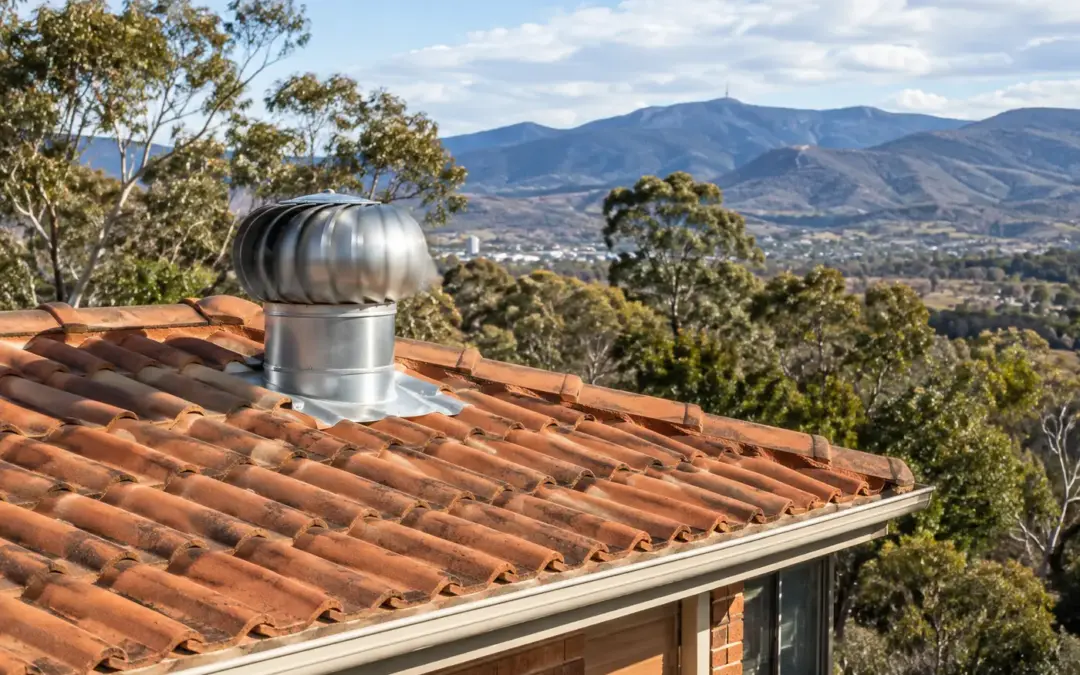
Every summer someone asks us the same thing from the bottom of the ladder: “Would a couple of whirlybirds fix this?” Usually it’s a hot upstairs bedroom, or a roof space that feels like an oven by mid afternoon. Sometimes it’s the opposite problem: mould spots on the ceiling in July. So, are whirlybirds worth it in Canberra? Our honest answer is that they can be, but only when they’re solving the right problem, and only when the rest of the roof space is set up to let them work.
Here’s how we think it through on a real house.
A whirlybird moves air. It doesn’t make cold air
A whirlybird is a wind driven roof vent. The turbine head spins in a breeze, and as it spins it pulls air out of the roof cavity (the space between your ceiling and the roof). Hot air rises, so it still vents a little on a still day, just less.
That’s all it does. It swaps roof space air for outside air. On a hot Canberra afternoon the outside air is hot too, so the best a whirlybird can do is stop the roof space getting even hotter than outside. That can make a real difference to how much heat radiates down through the ceiling. It won’t cool the house the way insulation or air conditioning does.
This next part surprises people. In most homes we look at, the ceiling insulation matters far more for comfort than any vent. If the batts are thin, gappy or flattened from years of tradies crawling over them, fix that first. Ventilation is the support act.
Canberra’s real ventilation problem shows up in winter
Most whirlybird sales talk is about summer heat. In Canberra we’d argue the stronger case is winter moisture.
On our cold, frosty nights, warm and damp air from inside the house meets a cold roof. Showers, cooking, drying clothes indoors and unflued gas heaters all add moisture. That vapour drifts up through downlight holes and ceiling gaps, hits the cold underside of the roof and condenses. Under a metal roof it can drip straight back down onto the insulation. Under tiles, it shows up as damp timbers, musty smells and black spots on the ceiling.
A roof space that can breathe dries out instead of staying damp. That’s where a whirlybird, or another type of roof vent, earns its keep. The other half of this picture is the membrane under the roof covering, which we cover in our post on whether your roof needs sarking. The two work together.
One check comes before any vent: find out where your bathroom exhaust fan actually goes. We regularly find fans that blow straight into the roof space instead of out through the roof or eaves. That’s piping steam directly into the problem area, and ducting it outside is often the cheapest win available.
Without fresh air coming in, a whirlybird works against you
Air has to come in somewhere before it can go out the top. In a well set up roof that intake is through eave vents or gaps at the eaves, so the whirlybird draws outside air in low and pushes it out high.
Plenty of Canberra homes have sealed eaves, especially brick veneer houses with lined soffits. Put a whirlybird on one of those and the easiest path for replacement air is up from the house itself, through downlights, the manhole and gaps at the cornice. In summer you end up pulling cooled air out of your living areas. In winter you pull out heated air. Neither is what you paid for.
So before we recommend one, we look at three things: where intake air will come from, how well the ceiling is sealed, and whether the insulation is in decent shape.
Whirlybird, solar vent or eave vents: how they compare
Whirlybirds aren’t the only option, and they aren’t always the best one.
Whirlybirds
Cheap to buy, no power needed, simple to fit. They depend on wind, so on a still, scorching day they do the least work right when you’d want the most. Over time the bearings wear and some start to squeak or wobble. A wobbling head is worth replacing before it lets go in a storm.
Solar powered roof vents
These use a small solar panel to drive a fan, so they push air hardest when the sun is strongest, wind or no wind. They cost more up front. Because they mostly run in daylight, they do less for overnight winter condensation than a vent that’s always open.
Eave and ridge vents
Low intake vents at the eaves, paired with an outlet up high, let the roof breathe by natural convection. They’re quiet and have no moving parts. On their own they shift less air than a turbine on a windy day, but they’re the intake that makes any top vent work properly.
For most homes the answer is a combination: some form of intake low, an outlet high, and a sealed ceiling between the roof space and your rooms.
Whirlybirds only leak when they’re fitted badly
A good unit on a proper base won’t let rain in, even in a summer thunderstorm. When we do find leaks around whirlybirds, it’s almost always the installation, not the vent.
On a metal roof the base has to be flashed into the profile of the roof sheet and sealed so water runs around it. Smearing silicone over a roughly cut hole is a common shortcut, and that sealant cracks after a few hot summers. On a tiled roof the whirlybird usually sits on a special flashing that replaces one or more tiles. If the flashing is the wrong profile for the tile, or it isn’t dressed down properly, wind driven rain finds its way under. If you’ve already got a damp patch near one, our guide to finding where a roof leak actually starts walks through the usual suspects.
This is also why we’re wary of the weekend DIY approach. Cutting a hole in a sound roof is easy. Keeping it watertight for decades is the actual job. Fitting new vents, and fixing badly fitted ones, is part of our roof repair work across Canberra.
Homes near the bush need ember protection
Large parts of Canberra back onto bush and grassland, from the Molonglo Valley to the edges of Tuggeranong and Weston Creek. A plain whirlybird has open gaps between its vanes, and during a fire embers can get into the roof space through those gaps.
If your home is in a bushfire prone area, choose a model fitted with a fine ember guard mesh, and check your property’s requirements before installing anything. We won’t recommend a vent that trades better airflow for a fire risk.
When we’d say yes, and when we’d say don’t bother
We usually recommend roof ventilation when we see:
- signs of condensation, like damp insulation, mould on ceilings or rust spots under a metal roof
- decent intake air already, or eaves where vents can be added
- insulation in good condition and a reasonably sealed ceiling
- a dark roof with a low pitch, which tends to trap more heat
We’d hold off when the insulation is poor (fix that first), when the eaves are fully sealed with no plan for intake, or when the only goal is a cooler house in summer. In those cases the money does more good elsewhere.
If we’re already up there doing a restoration, re-pointing or replacing tiles, it’s a sensible time to look at ventilation. Everything is accessible and any new flashings get sealed in with the rest of the work.
Get a straight answer for your roof
We’re tile and metal roofing specialists, and we’d rather tell you a whirlybird won’t help than sell you one that doesn’t. Book a free inspection and we’ll check your roof space, intake airflow and existing flashings, then give you an honest recommendation. If the answer is a new vent, or sorting out one that’s leaking, our Canberra roof repairs team can take care of it.
Common questions about whirlybirds
Do whirlybirds let rain in?
Not when they’re installed with the right flashing for your roof. The turbine head is shaped to shed water, and the base seals to the roof sheet or tile flashing. Leaks nearly always come from a roughly cut hole, the wrong flashing profile or sealant that has cracked with age.
Do whirlybirds work in winter?
Yes, and in Canberra that’s arguably when they matter most. They keep moving moist air out of the roof space, which helps prevent condensation and mould. The catch is a poorly sealed ceiling, because then they also draw heated air out of your rooms, so seal the gaps around downlights and the manhole.
How long do whirlybirds last?
It depends on the quality of the unit and how exposed your roof is to wind. The bearings usually wear out first, and you’ll notice squeaking, rattling or a head that wobbles. A worn head can often be replaced without disturbing the base flashing.
What is the best type of roof ventilation for my home?
There isn’t one best type. Most homes do well with intake vents low at the eaves and an outlet up high, either a whirlybird or a solar powered vent. The right mix depends on your roof shape, whether your eaves are sealed, and whether heat or condensation is the main problem.
Are solar roof vents better than whirlybirds?
They move more air on hot, still days because they don’t rely on wind. They cost more and do little at night, which is when winter condensation forms. For summer heat they have an edge. For moisture control, a passive vent that’s always working is often enough.
Can I install a whirlybird myself?
Some people do, but cutting into a roof that doesn’t currently leak carries real risk, and working at height is dangerous. Getting the flashing watertight on metal sheeting or tiles is the hard part. A poor install can cause leaks that cost more to fix than the vent was worth.