
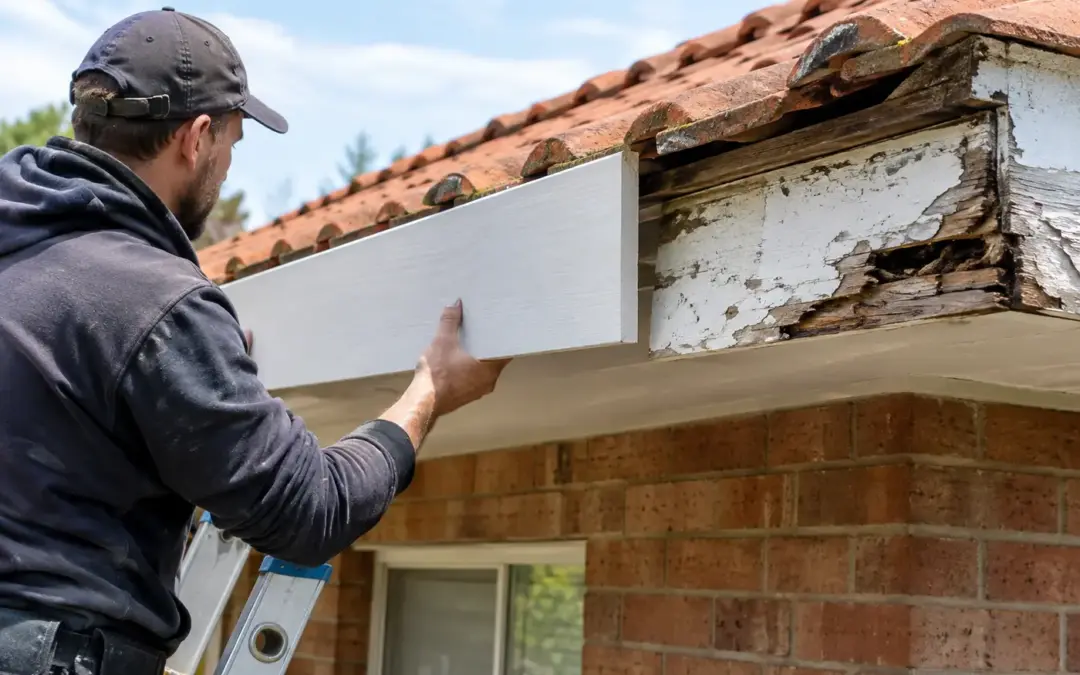
You notice it from the driveway first. The paint along the roof edge has gone chalky and started to peel, and there is a dark stain under one corner of the gutter. Push a screwdriver into the timber there and it sinks in like cake. That is a rotting fascia board, and the real question is not whether to fix it but how far to go. Fascia board replacement in Canberra usually comes down to one of three jobs: patch a section, replace the boards, or replace them and cover them in Colorbond. Picking the wrong one is how people end up paying twice.
We work on fascias on both tile and metal roofs, so here is how we decide, and how you can make a fair guess before anyone climbs a ladder.
The fascia does more work than it gets credit for
The fascia is the long board that runs along the bottom edge of your roof, fixed to the ends of the rafters. Your gutters hang off it. On a tiled roof, the bottom row of tiles sits just above it. It also closes off the roof space, so birds, possums and wind driven rain stay outside.
So when a fascia board fails, it rarely fails alone. The gutter brackets lose their grip, the gutter drops, water stops running to the downpipe and starts pouring over the edge, and the timber behind gets wetter still. It is a slow loop. Left long enough, the rot moves from the fascia into the rafter ends, and that is a much bigger repair.
What gives a rotting fascia away
Most of the fascia damage we see in Canberra starts with water sitting where it should not. Blocked gutters are the usual culprit, especially under big eucalypts, where leaves pack the gutter and it overflows straight down the face of the board. If yours fill up quickly, our post on how often Canberra gutters need cleaning is worth a read, because that one habit protects the fascia more than anything else.
Look for these from the ground or a short ladder:
- Paint that is cracked, flaking or worn back to bare grey timber
- Soft or spongy spots when you press a screwdriver in
- Gutters sagging, pulling away, or holding water at one end
- Corners where two boards meet opening into a gap
- Brown water stains on the eaves lining just inside the fascia
- Chewed edges (cockatoos and galahs like soft painted timber, and Canberra has plenty of both)
- Gaps behind the board where birds or possums have started getting into the roof
Canberra weather speeds all of this up. Strong summer sun breaks down the paint on the north and west sides first, then winter frosts work moisture into every crack it left behind. We often find a fascia that looks fine on the south side of a house and is badly weathered on the west.
Repair, replace or cover: how we pick
This is the part people want a straight answer on. It comes down to how sound the timber is, and how much of it is affected.
The paint is tired but the timber is solid
If the screwdriver will not go in anywhere and the gutters are sitting true, you do not need new boards. A proper prep and repaint will do it, or you can have the existing fascia wrapped in a Colorbond cover so it never needs painting again. Either is fine. Covering costs more up front and saves you the next few repaints.
The rot is limited to one or two spots
This is very common. The damage sits at a corner, near a downpipe outlet, or below a spot where the gutter has been overflowing for years. Here we cut out the bad length, splice in new treated timber, and refix the gutter. There is no point stripping the whole house when the rest of the fascia is sound.
The rot runs along most of a side, or into the rafters
Once soft spots are spread along a run, patching becomes false economy. Every splice is another joint for water to find. At this point we replace the full length of board, and we check every rafter end while it is exposed, because a new fascia nailed to rotten rafters will not hold.
The one thing we will not do is cover rot
Wrapping soft fascia in a Colorbond sleeve hides the problem and traps moisture against it, while the gutter screws keep losing grip underneath. A cover should only ever go over timber that is solid or freshly replaced. If a quote offers to cover your fascia without anyone having probed it first, ask why.
That is the approach behind our Colorbond fascia cover and replacement service: replace what is rotten, then cover the lot so the timber is protected from sun and water from then on.
The job is more than swapping a board
On a typical single storey house, fascia replacement runs roughly like this:
- Gutters come off, along with the downpipe connections at the top.
- On a tiled roof, the bottom row of tiles may need lifting to free the old board.
- The old fascia comes off and every rafter end is checked. Rotten ends are repaired before anything new goes on.
- New treated, primed timber is fixed, with the corners joined properly so they do not open up again.
- The board is painted, or covered in Colorbond.
- Gutters go back up with the correct fall to the downpipes, and the tiles are refitted.
Because the gutters are off anyway, this is the cheapest moment to replace them if they are rusted or split. Doing them later means paying to remove and refit them twice. We cover what drives gutter pricing in our guide to replacing gutters in Canberra, which helps if you are weighing up both jobs together.
Five things that move the price
We do not publish a flat rate for fascia work, because two houses on the same street can be very different jobs. This is what we look at when we quote.
Length and access. The metres of fascia matter, but so does the height. A two storey house or a steep block can need extra edge protection or scaffold, and that can cost more than the timber.
How much rot is hiding. Rafter ends are the wild card. We can usually spot trouble from outside, but the true extent only shows once the board is off. A good quote tells you how hidden rafter repairs will be handled before the job starts, not after.
Roof type. Tiled roofs take more care at the edge than metal ones, because the bottom tiles have to come up and go back down without cracking.
Finish. Painted timber is cheaper on the day. A Colorbond cover costs more but takes repainting off your list.
Gutters. Refitting your existing gutters is cheaper than new ones, provided they are in good shape. If they are not, doing both jobs together saves on labour.
Older suburbs have the timber problems
The fascia on your house depends a lot on when it was built. Many homes in the established parts of Belconnen, Woden and the inner north and south still have their original painted timber fascia, often under several coats of paint and a few old patches. That is where most of our rot repairs happen.
A lot of newer homes in Gungahlin and the Molonglo Valley were built with steel fascia and gutter systems instead. Those do not rot, but they can dent, rust at cut edges, or work loose in strong wind. If yours is steel, the fix is a different conversation from the timber one above.
Common questions about fascia board replacement
How much does it cost to replace a rotted fascia board?
It depends on how much of the board is rotten, whether the rafter ends behind it are affected, the height of the house and whether the gutters are being replaced too. A single damaged section is a far smaller job than a full side. We quote after seeing it rather than guessing over the phone.
How often should fascia boards be replaced?
Well maintained timber fascia lasts a long time, so there is no fixed schedule. What shortens its life is failed paint and overflowing gutters. Keep the paint sound and the gutters clear and you push replacement a long way off, and a Colorbond cover over solid timber takes most of the weathering away.
Can I replace a fascia board myself?
Some handy owners do it on a low single storey house. The catch is that the gutter has to come off and go back on with the right fall, tiles may need lifting, and you are handling long boards at height. Get the fall wrong and you simply create a new overflow point, so for most people it is a job for someone with the right gear.
How do I fix a rotted fascia board?
Probe it first to find where the soft timber ends. Small, contained rot can be cut out and replaced with a spliced length of new treated timber, then primed and painted. If the rot runs along most of the board or into the rafter ends, filler and patches will not last and the board should be replaced.
Is a Colorbond fascia cover worth it?
Yes, if the timber underneath is sound and you are tired of repainting, because the steel takes the sun and rain instead of the timber. It is not a fix for rot, though, and should never go over soft boards.
Should I replace my gutters at the same time as the fascia?
If the gutters are rusted, split or too small for the roof, yes, since they have to come off for the fascia work anyway. If they are in good condition, they can be cleaned and refitted.
Find out how far the rot has gone
If your fascia is flaking, sagging or soft in spots, it is worth knowing how far the damage goes before the next big storm tests it. Book a free inspection and we will tell you plainly whether you need a repaint, a patch or new boards, then quote our fascia replacement work from there.