
The call usually goes something like this. Someone has had three roofers through, the old tiles are cracked and porous, and the quotes for a new roof are nowhere near each other. One is a single line with a total. Another runs to two pages. The third is somewhere in between and the owner has no idea which one is fair.
We get it. Roof replacement cost in Canberra is hard to judge from the outside because most of what you pay for is stuff you never see: battens, sarking, flashings, disposal, scaffold. This post walks through what actually moves the price, so you can read a quote properly and ask the right questions before you sign anything.
One honest note first. We won’t give you a blanket per square metre figure here, because a number pulled from a national average tells you very little about your roof. Two homes on the same street can come in miles apart once you get up top and look.
Size is the starting point, but pitch and shape decide the rest
Every quote starts with the roof area. It’s the actual surface area of the roof, not the floor area of the house, and that difference catches people out. Eaves, overhangs and a steep pitch all add square metres your floor plan doesn’t show.
Then comes shape. A simple gable roof (two flat planes meeting at a ridge) is the quickest thing we ever replace. A hipped roof with valleys, a couple of dormers and an extension tacked on in the eighties is a different job. Every valley, hip and change of direction needs cutting, flashing and extra labour. So a smaller roof with lots of angles can cost more than a bigger, plainer one.
Pitch matters for safety as much as time. Once a roof gets steep, crews need more edge protection and move more slowly. Two-storey homes add scaffold and make lifting materials harder. None of that is padding. It’s what keeps people from falling off your house.
Tile to Colorbond is the job we quote most
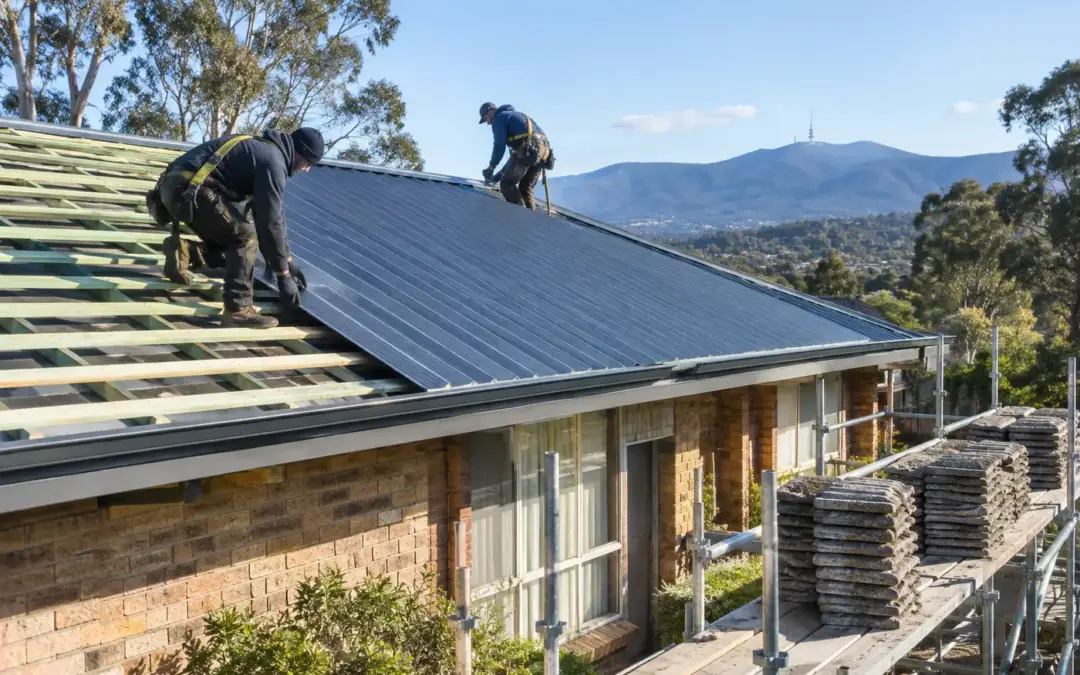
A lot of Canberra homes built in the seventies and eighties still wear their original concrete or terracotta tiles. When those tiles reach the end of their life, many owners choose to go to Colorbond steel rather than retile. Steel is much lighter, which takes load off an older frame, and it copes well with our frosty winters and summer storms.
The switch does add steps a like-for-like job doesn’t have. Tiles sit on timber battens spaced for tiles, and steel needs battens spaced for steel, so the old ones usually come off and new ones go on. Every tile has to be stripped, lowered and taken away, and that removal and disposal is a real line on the quote. Ridge capping, valleys and flashings are all replaced with steel versions to suit.
If you’re still deciding between materials, our side by side look at Colorbond and tile for Canberra homes covers weight, noise, heat and look in more detail than we can fit here.
The parts of the quote you never see
This is where cheap quotes and proper quotes usually split. The roofing sheets or tiles are the visible part. Underneath, a new roof should include:
- Sarking or roof blanket (a membrane or insulated layer under the roofing that catches condensation and adds a bit of thermal help)
- New battens, or a clear note if the existing ones are being reused
- Flashings where the roof meets walls, chimneys and skylights
- Valley irons, ridge capping and barge capping
- Gutters and downpipes, if they’re part of the job
- Removal, tip fees and site clean-up
If a quote doesn’t mention sarking, ask about it. On a Canberra home it earns its keep. Cold nights and warm days are exactly the conditions where condensation forms on the underside of a steel roof, and without something to catch it, that moisture drips onto your insulation and ceiling.
Gutters are the other big swing item. Some quotes include new gutters and downpipes, some don’t. It usually makes sense to replace them at the same time if they’re getting old, since the crew and scaffold are already there.
Things that can push the price up once work starts
Most surprises come from what’s under the old roof. We’d rather you hear about them now than halfway through the job.
Rotten or sagging timber
Years of slow leaks can soften rafters and battens. You often can’t see it until the roofing comes off. A good quote says how timber repairs will be priced if they turn up, so you’re not left guessing.
Asbestos roofing
Some older Canberra homes, sheds and garages have asbestos cement roofing. If yours does, it can’t simply be pulled off and tipped. It has to be removed by a licensed asbestos removalist and disposed of under strict rules, and that adds cost and time. If you’re not sure what your roof is made of, don’t drill it, cut it or water blast it. Get it identified first.
Bushfire rating on the block
Homes on the edge of the city, near the reserves and the ranges, may sit in a bushfire prone area. That can affect which materials and ember sealing details are suitable. Ask whether your block carries a rating before you settle on a product.
Access
Steep driveways, tight side paths, pools and big trees all slow down getting materials up and waste down. A roof that’s easy to reach from the street is cheaper to replace than one tucked behind a two-storey neighbour.
How to compare three quotes that look nothing alike
Put them side by side and go line by line. The total is the last thing to look at, not the first.
Check that each quote uses roughly the same roof area. If one is much smaller, someone has measured wrong or left bits out. Look for sarking, battens, flashings and gutters on every quote. Check who takes the old roof away and whether disposal is included. And read the warranty wording properly: who stands behind the workmanship, and for how long.
For what it’s worth, we back our work with a 15 year warranty, and we’d encourage you to ask every roofer you talk to exactly what their warranty covers. A long warranty only means something if it’s in writing and the business will still be around to honour it.
A single-line quote isn’t automatically dodgy. But if you can’t tell what’s included, you can’t compare it, and you can’t hold anyone to it later either.
Sometimes the cheapest option is not replacing at all
We say this to a fair few people who ring us for a new roof. If the tiles are sound and the problems are mostly worn pointing, a few broken tiles and tired paint, a restoration can buy you years for far less money. Replacement makes sense when the roofing itself is failing: tiles crumbling, steel rusted through, or leaks that keep coming back no matter what’s patched.
We’ve laid out the tipping points in our guide to choosing between restoring and replacing a roof. It’s worth reading before you commit to the bigger spend.
Getting a real number for your roof
The only way to get a replacement price you can rely on is for someone to get up on the roof, measure it and look at what’s underneath. We work on tile and metal roofs right across Canberra, from Gungahlin to Tuggeranong, and we’ll tell you plainly whether you need a new roof or whether a repair or restoration will do the job. If replacement is the right call, have a look at how we handle new roof installations in Canberra and get in touch for an itemised quote.
Common questions about replacing a roof in Canberra
Is $30,000 too much for a roof?
It depends entirely on what’s being replaced. For a large, complicated or two-storey roof, or a tile to Colorbond job that includes new gutters, it may be fair. For a small, simple roof it may be high. Compare quotes on the same roof area and the same inclusions rather than judging the total on its own.
What is the most expensive part of replacing a roof?
Labour and materials make up the bulk of it, but the cost that surprises people most is everything around the roofing itself: stripping and disposing of the old roof, scaffold and safety gear, new battens and flashings. Asbestos removal or rotten timber, if found, can also add a significant amount.
What is the cheapest option for a new roof?
On a simple roof, steel sheeting is usually quicker to install than tiles, which helps keep labour down. But the cheapest option overall is often not a new roof at all. If the existing roofing is structurally sound, a restoration or targeted repair can cost far less and still give you many more years.
What is the best time of year for roof replacement?
In Canberra, spring and autumn are the most comfortable seasons to have a roof off, with milder temperatures and fewer big storms than mid summer. Work goes ahead year round, though. A good crew watches the forecast and only opens up as much roof as it can make watertight before the end of each day.
How long does a roof replacement take?
That depends on the size and shape of the roof, the materials, access and the weather. A simple roof goes faster than one with lots of valleys, hips and flashings. Your roofer should give you an expected timeframe on the quote and explain what could stretch it.
Do I need to move out while the roof is replaced?
Most people stay home. It is noisy and dusty during the day, and you’ll want to cover belongings in the roof space, but the house stays weathertight overnight if the job is run properly.